
Introduction
Traditional insurance follows a familiar process: a policyholder experiences a loss, submits a claim, provides supporting documents, and waits for the insurer to assess the damage before approving a payout.
While this model works across many insurance products, it can become challenging when losses are widespread, difficult to assess, or time-sensitive. Natural disasters, extreme weather events, agricultural disruptions, and travel interruptions can create thousands of claims simultaneously, placing pressure on insurers and delaying financial recovery for policyholders.
A different insurance model is gaining attention: parametric insurance.
Instead of calculating compensation based on the actual loss incurred, parametric insurance uses predefined conditions or measurable events to trigger a payout. When an agreed parameter reaches a specified threshold, the policy can initiate payment without requiring a conventional loss assessment.
Combined with AI, satellite imagery, Internet of Things (IoT) sensors, and real-time data platforms, this model creates opportunities for insurers to deliver faster, more transparent, and more responsive protection.
1. What Is Parametric Insurance?
Parametric insurance is a model in which payouts are determined by predefined measurable parameters rather than the traditional assessment of actual financial loss.
These parameters may include rainfall levels, wind speeds, earthquake intensity, temperature variations, or other independently measurable indicators.
For example, consider a farmer who purchases agricultural insurance against insufficient rainfall.
The policy may specify that if rainfall in a particular region falls below an agreed threshold during a defined growing period, the farmer becomes eligible for a predetermined payout.
Once the relevant data confirms that the trigger condition has been met, the payout process can begin according to the policy terms.
This differs from conventional agricultural insurance, where the insurer may need to inspect the affected fields, assess crop damage, verify the loss, and determine the compensation amount.
The key distinction is that parametric insurance responds to the occurrence of a predefined event rather than calculating the precise financial loss after it happens.
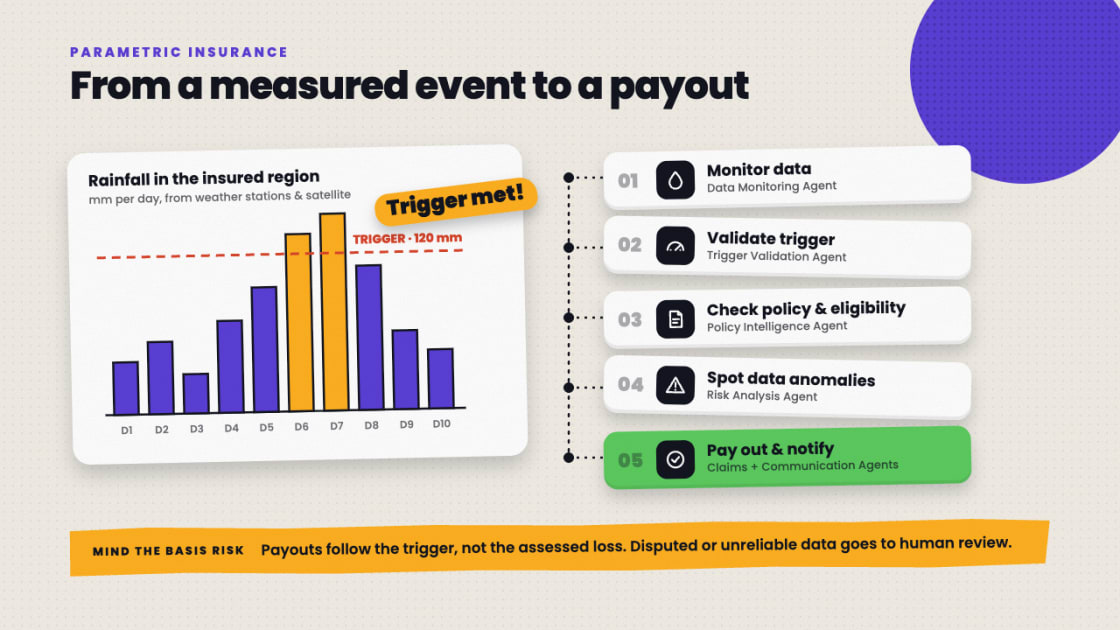
However, the payout may not always match the policyholder's actual loss. This difference, known as basis risk, is an important consideration when designing these products.
2. Why Insurers Are Exploring Parametric Models
Several factors are increasing interest in parametric insurance.
Climate-related disruptions are becoming more challenging to manage. Extreme rainfall, droughts, heatwaves, floods, and storms can affect large geographic areas simultaneously.
Traditional claims processes may struggle when thousands of policyholders require assistance at the same time.
Parametric models offer an alternative by using measurable external data to establish whether policy conditions have been met.
Key opportunities include:
Faster payouts: Predefined triggers can reduce dependence on lengthy individual loss assessments.
Greater transparency: Policyholders know the conditions that determine whether a payout is activated.
Scalable claims processing: Automated trigger verification can support large numbers of policyholders.
Protection against emerging risks: Products can be designed around specific measurable events that conventional policies may not address effectively.
Improved financial planning: Businesses can obtain predefined financial protection against selected operational disruptions.
For insurers, the opportunity is to develop products that respond more quickly to specific risks while improving operational efficiency.
3. How AI and Real-Time Data Are Transforming Parametric Insurance
The effectiveness of parametric insurance depends heavily on the accuracy, availability, and reliability of the data used to verify trigger conditions.
This is where AI and connected technologies become important.
Satellite imagery and geospatial intelligence
Satellite data can help monitor rainfall, vegetation conditions, flood exposure, and changes in land characteristics. AI can analyze these images to identify environmental patterns and support the verification of predefined insurance triggers.
IoT-enabled monitoring
Connected sensors can capture information such as temperature, humidity, water levels, and equipment conditions. This information can support parametric products designed for agriculture, logistics, manufacturing, and infrastructure.
AI-powered risk modelling
Machine learning models can analyze historical weather patterns, geographic exposure, and other relevant datasets to support risk assessment and product pricing.
Automated trigger verification
AI-enabled workflows can collect data from approved sources, compare measurements against policy conditions, identify whether a trigger has been reached, and initiate the appropriate verification process.
Intelligent claims coordination
Once a trigger is confirmed, automated workflows can retrieve policy information, validate eligibility, prepare payout instructions, and notify relevant teams.
The result is an insurance process that can move from event detection to payout coordination with fewer manual steps.
AI supports the analysis and coordination, while the underlying policy terms determine the actual conditions for payment.
4. Where Parametric Insurance Can Create New Opportunities
The potential applications extend beyond traditional weather-related insurance.
Agriculture and crop protection
Farmers are exposed to rainfall variability, drought, extreme temperatures, and other environmental conditions.
Parametric agricultural insurance can use weather station data, satellite observations, and predefined thresholds to support payouts when specified conditions occur.
This can help farmers access financial support more quickly following qualifying events.
Travel and aviation
Flight delays, cancellations, and other travel disruptions can create financial inconvenience for passengers.
Parametric travel products can be designed around predefined conditions such as a flight delay exceeding an agreed duration.
Automated access to verified flight information can help insurers determine eligibility without requiring lengthy individual claims submissions.
Climate and natural disaster protection
Floods, cyclones, earthquakes, and extreme weather events can affect businesses, communities, and infrastructure.
Parametric coverage can be structured around measurable environmental indicators, providing predefined financial support when policy conditions are satisfied.
Business interruption
Businesses dependent on specific environmental or operational conditions may face unexpected disruption.
For example, a business operating in a weather-sensitive location could explore coverage linked to predefined environmental measurements.
The challenge is designing triggers that accurately reflect the exposure being insured and provide meaningful protection when disruptions occur.
5. The Role of Agentic AI in Parametric Insurance Operations
As parametric insurance products become more data-driven, managing the complete process requires coordination between multiple systems.
Agentic AI can help connect these activities through specialized agents working within defined operational boundaries.
Consider a parametric insurance policy covering extreme rainfall.
A connected AI workflow could involve:
Data Monitoring Agent: Retrieves rainfall measurements from approved weather data sources.
Trigger Validation Agent: Compares the recorded measurements with the conditions defined in the policy.
Policy Intelligence Agent: Retrieves relevant policy information and checks applicable eligibility requirements.
Risk Analysis Agent: Identifies inconsistencies or data anomalies that require additional investigation.
Claims Coordination Agent: Prepares the payout workflow and coordinates required internal approvals.
Customer Communication Agent: Generates policyholder notifications explaining the trigger outcome and next steps.
An orchestration layer coordinates these activities and tracks the progress of each stage.
This approach can reduce repetitive information gathering, improve operational visibility, and support faster processing.
However, automated workflows must incorporate data validation, audit trails, access controls, and escalation procedures. Disputed measurements, unreliable data sources, and ambiguous policy conditions should be routed for appropriate human review.
6. The Challenges Insurers Must Address
Despite its potential, parametric insurance introduces several important considerations.
Basis risk: The predefined trigger may not perfectly reflect the actual loss experienced by the policyholder. Someone may suffer significant damage without the specified trigger being reached.
Data reliability: Incorrect or delayed information from weather stations, sensors, or external providers can affect payout decisions.
Product design: Triggers must be relevant to the insured risk, clearly defined, and understandable to policyholders.
Regulatory requirements: Insurers must ensure that products, disclosures, payout mechanisms, and data practices comply with applicable insurance regulations.
Technology integration: Data sources, policy administration platforms, risk models, and payment systems must work together reliably.
Customer trust: Policyholders need to understand how triggers are measured, what qualifies for a payout, and why a particular outcome was reached.
Successful adoption will depend on balancing automation with transparency, reliable data, and appropriate governance.
7. Building the Technology Foundation for Data-Driven Insurance
To operationalize parametric insurance at scale, insurers need an architecture that connects external data, policy information, AI capabilities, and enterprise workflows.
A practical foundation includes four layers:
Data Integration Layer: Connects weather feeds, satellite imagery, IoT sensors, geospatial information, and internal insurance systems.
AI and Analytics Layer: Supports risk modelling, anomaly detection, trigger analysis, and predictive insights.
Orchestration Layer: Coordinates data validation, policy checks, workflow execution, and claims-related activities.
Security and Governance Layer: Establishes data access controls, decision traceability, audit mechanisms, and human approval requirements.
These capabilities allow insurers to move towards more connected insurance operations while maintaining control over how data-driven decisions are made.
How SNS Square Fits Into the Future of Parametric Insurance
The evolution of parametric insurance requires more than automated payouts. It requires the integration of external data sources, enterprise insurance platforms, AI capabilities, and governed operational workflows.
SNS Square's focus on Data and Agentic AI, intelligent automation, and enterprise integration aligns with the technology foundations needed to support this transformation.
Through its Agentic Workbench approach, insurers can explore coordinated AI workflows for data retrieval, trigger monitoring, policy information analysis, exception identification, and claims administration.
By connecting specialized agents with enterprise systems through orchestration and governance, organizations can develop more responsive insurance operations while maintaining transparency and human oversight.
The broader opportunity is to help insurers move towards data-driven products and connected workflows that respond more effectively to changing risk conditions.
Conclusion
Parametric insurance represents an important shift in how insurance protection can be designed and delivered.
By connecting predefined policy triggers with real-time data, satellite intelligence, IoT sensors, and AI-powered workflows, insurers can create opportunities for faster payouts and more responsive risk protection.
However, the success of this model depends on more than automation. Reliable data, carefully designed triggers, regulatory alignment, and transparent policy conditions remain essential.
As AI capabilities continue to evolve, parametric insurance could become an increasingly important part of how insurers address climate exposure, operational disruptions, and emerging risks.
The future of insurance will not be defined only by how accurately losses are assessed after an event. It will also depend on how intelligently insurers can recognize risk, respond to changing conditions, and deliver protection when policyholders need it most.
Comments0
Please login to join the conversation
Be the first to comment!