

Introduction
When a critical position opens up, most organizations immediately look outside. Recruitment teams publish job descriptions, approach candidates, engage hiring partners, and begin the search for suitable talent.
But what if the skills required for that role already exist within the organization?
A data analyst may have the capabilities to move into business intelligence. A software engineer may have developed expertise in AI engineering through independent projects. An operations professional may possess the process knowledge needed to lead an automation initiative.
These capabilities often remain undiscovered because organizations primarily understand their workforce through job titles, departments, and reporting structures rather than the skills employees actually possess.
This is where the concept of an internal talent marketplace becomes important.
An internal talent marketplace connects employees with available projects, temporary assignments, learning opportunities, and open positions based on their skills, experience, and career interests. Instead of treating recruitment as an external hiring exercise, organizations can begin by identifying and developing the talent they already have.
With AI-powered skills intelligence, this approach is becoming an important part of modern workforce strategy.
1. Why Organizations Overlook Their Existing Talent
Most enterprises maintain detailed employee records, including job titles, qualifications, experience, performance history, and reporting relationships.
However, these records do not always provide a complete picture of employee capabilities.
An employee's current role may represent only a portion of what they can contribute. Their additional certifications, project experience, technical interests, and transferable skills may not be reflected in traditional HR systems.
This creates a visibility problem.
For example, an organization planning to establish an AI automation team may immediately begin external recruitment. Meanwhile, employees in software development, data analytics, and business operations may already possess relevant foundational skills.
Without a structured way to identify these capabilities, the organization risks overlooking suitable internal candidates.
The result can be unnecessary recruitment costs, longer hiring cycles, and missed opportunities for employee development.
The challenge is not always a shortage of talent. Sometimes it is the inability to identify talent that already exists.
2. What Is an Internal Talent Marketplace?
An internal talent marketplace is a digital platform that connects an organization's workforce with opportunities based on skills, experience, interests, and business requirements.
It moves beyond traditional job posting systems by creating visibility into the capabilities available across the organization.
Employees can discover:
Open positions in other departments.
Short-term projects and cross-functional assignments.
Mentoring and knowledge-sharing opportunities.
Learning programmes linked to future roles.
Opportunities to develop emerging technical and leadership skills.
Managers and HR teams can use the platform to identify employees who may be suitable for critical projects or future vacancies.
For example, a company planning a cloud modernization initiative could identify employees with relevant infrastructure experience, recommend additional certifications, and create a development pathway towards cloud engineering roles.
The marketplace creates a more flexible connection between workforce capabilities and changing business requirements.
3. How AI Is Making Internal Talent Discovery More Intelligent
Traditional internal job portals generally depend on employees searching for opportunities and managers identifying suitable candidates.
AI can make this process more proactive.
By analyzing structured and approved workforce information, AI-powered platforms can help organizations understand employee capabilities beyond their current job descriptions.
Skills Intelligence: AI can identify skills from employee profiles, project histories, certifications, and verified work experience.
Intelligent Talent Matching: Matching systems can compare employee capabilities with the requirements of open positions, projects, and business initiatives.
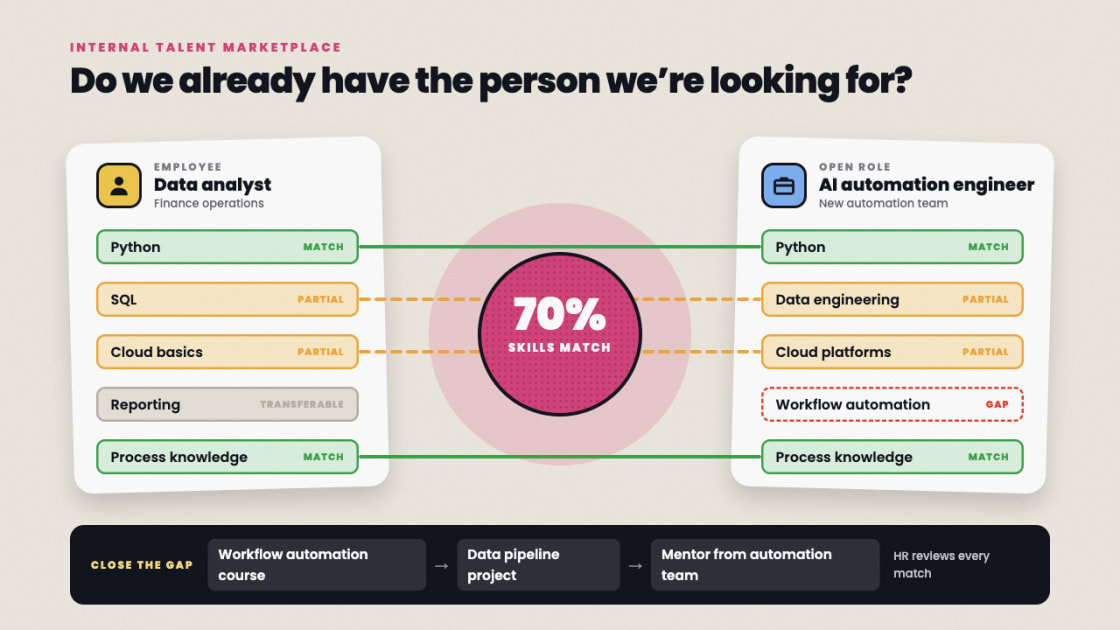
Transferable Skills Identification: AI can identify related capabilities that may allow an employee to transition into a different role with appropriate training.
Personalized Learning Recommendations: Employees can receive learning suggestions based on the skills needed for their desired career progression.
Workforce Demand Forecasting: Organizations can compare existing skills with anticipated business requirements to identify future talent gaps.
Consider an enterprise that needs additional professionals for an AI implementation project.
An AI-powered talent marketplace could identify employees with experience in Python, data engineering, cloud platforms, and workflow automation. It could then highlight the skills they already possess, identify missing competencies, and recommend suitable learning pathways.
Instead of starting every search externally, HR can evaluate the available internal talent pool first.
AI should support this process through explainable recommendations and verified employee information, rather than making unreviewed employment decisions.
4. Moving From External Recruitment to Internal Talent Mobility
Internal talent marketplaces can change how organizations approach workforce planning.
Traditional recruitment usually follows a linear process: identify a vacancy, create a job description, source external candidates, conduct interviews, and complete onboarding.
Internal talent mobility introduces another possibility: identify whether existing employees can fulfil the requirement through a role transition, project assignment, or targeted upskilling.
Consider a financial services company that needs professionals with data analytics capabilities.
Rather than immediately recruiting an entirely new team, HR could identify employees from finance operations, reporting, and business analysis who already have relevant analytical experience.
With targeted learning and practical project exposure, some of these employees may be able to transition into the new function.
This creates several potential advantages:
Reduces dependence on external recruitment for selected roles.
Preserves organizational and business knowledge.
Creates visible career progression opportunities.
Helps employees develop capabilities aligned with business demand.
Supports faster deployment of talent across departments.
External hiring will remain essential for genuinely new or highly specialized capabilities. The opportunity is to make internal mobility a meaningful part of the hiring strategy rather than an afterthought.
5. The Business Case: Why Internal Talent Marketplaces Matter
The value of an internal talent marketplace extends beyond filling vacancies.
Lower recruitment costs: Identifying qualified internal candidates can reduce some sourcing, recruitment, and onboarding expenses.
Faster deployment: Employees who already understand the organization's systems, processes, and culture may require less transition time.
Improved retention: Clear opportunities to move into new roles and develop skills can give employees stronger reasons to build their careers within the organization.
Better workforce utilization: Managers gain visibility into capabilities that may otherwise remain underused.
Greater organizational agility: Teams can be formed around changing business priorities instead of relying entirely on fixed departmental structures.
The impact should be measured through internal hiring rates, time to fill roles, employee retention, project staffing speed, skills development, and workforce productivity.
6. Why Internal Talent Marketplaces Often Fail
Despite their potential, implementing an internal talent marketplace is not simply a matter of purchasing a platform.
Several organizational challenges can limit adoption.
Incomplete skills data: Employee profiles may not reflect current capabilities, certifications, project experience, or interests.
Manager resistance: Managers may hesitate to release strong employees to other departments because of immediate delivery requirements.
Lack of employee participation: Employees may not update their profiles or explore opportunities if the platform does not offer meaningful career value.
Unclear career pathways: Identifying a skills match is not enough if employees lack access to training, mentoring, and practical experience.
Disconnected HR systems: Recruitment, learning, performance, and employee information may exist across different platforms, making talent discovery difficult.
Organizations need more than technology. They need policies that encourage internal movement, leadership support, transparent opportunity allocation, and a culture where employee development is shared across departments.
7. Building an AI-Enabled Internal Talent Marketplace
A successful internal talent marketplace requires connected data, intelligent matching, and a structured approach to employee development.
A practical technology foundation includes four capabilities.
Unified Workforce Data: Connects employee profiles, skills records, project histories, learning platforms, and internal job opportunities.
AI-Powered Skills Intelligence: Identifies existing capabilities, transferable skills, and potential development areas.
Intelligent Matching and Recommendations: Connects employees with suitable roles, projects, mentors, and learning opportunities.
Governance and Integration: Ensures employee data is handled responsibly, recommendations are explainable, and HR decisions remain subject to appropriate review.
Organizations should begin with a focused pilot, such as identifying internal candidates for a high-demand technology function. They can then evaluate the quality of recommendations, employee participation, manager adoption, and actual placement outcomes before expanding the marketplace.
How SNS Square Fits Into the Future of Workforce Intelligence
As enterprises rethink how they identify and deploy talent, the ability to connect workforce data with business requirements becomes increasingly important.
SNS Square focuses on Data and Agentic AI, intelligent automation, and enterprise integration to support organizations in building connected, data-driven operating environments.
Through its Agentic Workbench approach, enterprises can explore AI-enabled workflows for skills intelligence, workforce analysis, talent matching, learning recommendations, and HR process coordination.
By connecting workforce information with enterprise applications through orchestration and governance, organizations can build a more informed approach to internal mobility and capability development.
The broader opportunity is to help HR teams move beyond maintaining employee records towards understanding the capabilities available across the enterprise and aligning them with future business needs.
Conclusion
The next workforce opportunity may not always come from hiring someone new. It may come from recognizing what existing employees are already capable of achieving.
Internal talent marketplaces provide a structured way to connect employee skills with emerging business opportunities. With AI-powered skills intelligence, organizations can identify transferable capabilities, support career transitions, and respond more effectively to changing workforce requirements.
This does not eliminate the need for external recruitment. Instead, it creates a more balanced talent strategy in which organizations understand and develop their existing workforce before looking beyond it.
As business priorities and technology requirements continue to evolve, the organizations that can identify, develop, and deploy their internal talent effectively will be better positioned to adapt.
The future of talent acquisition may begin with a question HR has not always asked: Do we already have the people we are looking for?
Comments0
Please login to join the conversation
Be the first to comment!