

Why the next phase of AI in healthcare is about understanding, not diagnosis
OpenAI has taken a decisive step into the healthcare space with the launch of ChatGPT Health, a new feature designed to help users better understand their personal wellness data. Announced in early January 2026, the update reflects a growing global shift: people are increasingly turning to AI not for diagnosis, but for clarity, context, and everyday health awareness.
According to OpenAI, hundreds of millions of users already ask ChatGPT health-related questions each week. ChatGPT Health aims to respond to this demand more responsibly by offering a dedicated, privacy-aware experience focused on personalised, non-diagnostic insights, rather than medical advice.
What ChatGPT Health Actually Does
ChatGPT Health allows users to securely connect to health-related information, such as:
Electronic medical records
Lab reports and test results
Data from wellness and fitness applications
Once connected, the system can help explain medical terminology, summarise reports, identify trends over time, and suggest general lifestyle considerations. Importantly, it does not diagnose conditions or recommend treatments.
Instead, ChatGPT Health functions as a digital understanding layer helping users prepare for more informed, productive conversations with healthcare professionals.
This distinction is critical. ChatGPT Health is positioned as supportive intelligence, not a replacement for clinicians.
Why This Matters Now
Healthcare systems worldwide are under growing strain. Patients often struggle to interpret complex reports, recall medical guidance, or track long-term wellness patterns across fragmented systems.
AI-powered tools like ChatGPT Health address a real gap:
making health information more accessible without overstepping professional boundaries.
This approach mirrors a broader shift in enterprise technology as well. Across innovation ecosystems such as Global Capability Centre (GCC) environments in Bengaluru, AI is increasingly deployed to augment human decision-making, not automate it blindly. The same principle applies here—AI as an enabler of understanding, not authority.
Privacy and Trust at the Core
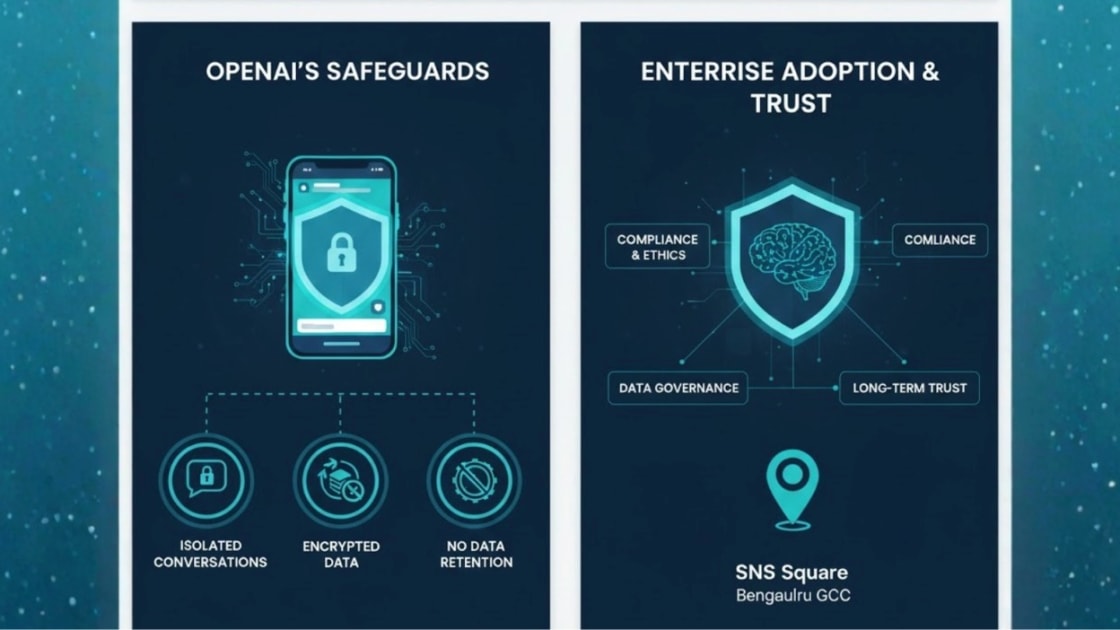
Health data is among the most sensitive forms of personal information, and OpenAI has emphasised privacy as a foundational element of ChatGPT Health. According to the company:
Health conversations are isolated from general chats
Data is encrypted during use
Information is not retained beyond the user interaction
Despite these safeguards, scrutiny remains high. Users, regulators, and healthcare professionals are watching closely, recognising that even well-intentioned systems must be designed with strong governance, auditability, and clear boundaries.
This discussion aligns closely with enterprise conversations around responsible AI adoption, an area of growing focus across platforms and ecosystems such as SNS Square Bengaluru GCC, where AI implementation is increasingly tied to compliance, ethics, and long-term trust.
Opportunities and Ethical Boundaries
From a user perspective, ChatGPT Health offers tangible benefits:
Better understanding of lab results and reports
Clearer summaries of medical records
Smarter, more informed questions for doctors
Improved engagement with personal wellness
At the same time, ethical boundaries remain essential. Over-reliance on AI for health interpretation, misreading AI-generated context, or sharing incomplete data can lead to confusion or false reassurance.
OpenAI’s insistence on clear disclaimers and professional consultation reflects an awareness that responsibility must scale alongside capability.
A Signal of Where AI in Healthcare Is Headed
ChatGPT Health is less about disruption and more about direction.
It signals a future where AI helps individuals navigate information overload, while healthcare professionals remain central to diagnosis, treatment, and care decisions.
For enterprises, policymakers, and technology leaders, the takeaway is clear:
The next phase of AI in healthcare will be defined not by capability alone, but by governance, transparency, and human oversight.
As AI platforms mature, ecosystems that successfully balance innovation with responsibility across regions and industries will set the standard for sustainable adoption.
Comments0
Please login to join the conversation
Be the first to comment!