

India’s life insurance sector may be approaching a structural shift in how distributor commissions are paid. A committee under the Life Insurance Council is reportedly evaluating proposals to cap or stagger distributor payouts, with the objective of strengthening long-term sustainability, transparency, and customer trust across the industry.
While final decisions are yet to be announced, the discussions signal a broader rethinking of incentive structures in life insurance, particularly as the sector adapts to tighter regulatory scrutiny, evolving customer expectations, and digital-first distribution models.
Why Distributor Payouts Are Under Review
Distributor commissions have historically played a central role in driving insurance penetration and scale across India. However, large upfront payouts have also contributed to several structural challenges, including:
Higher product costs are passed on to customers
Increased policy lapses linked to mis-selling incentives
Short-term sales focus over long-term customer value
Pressure on insurers’ profitability and persistency metrics
As the market matures, regulators and industry bodies are increasingly focused on aligning growth with policy quality, customer outcomes, and trust rather than pure volume.
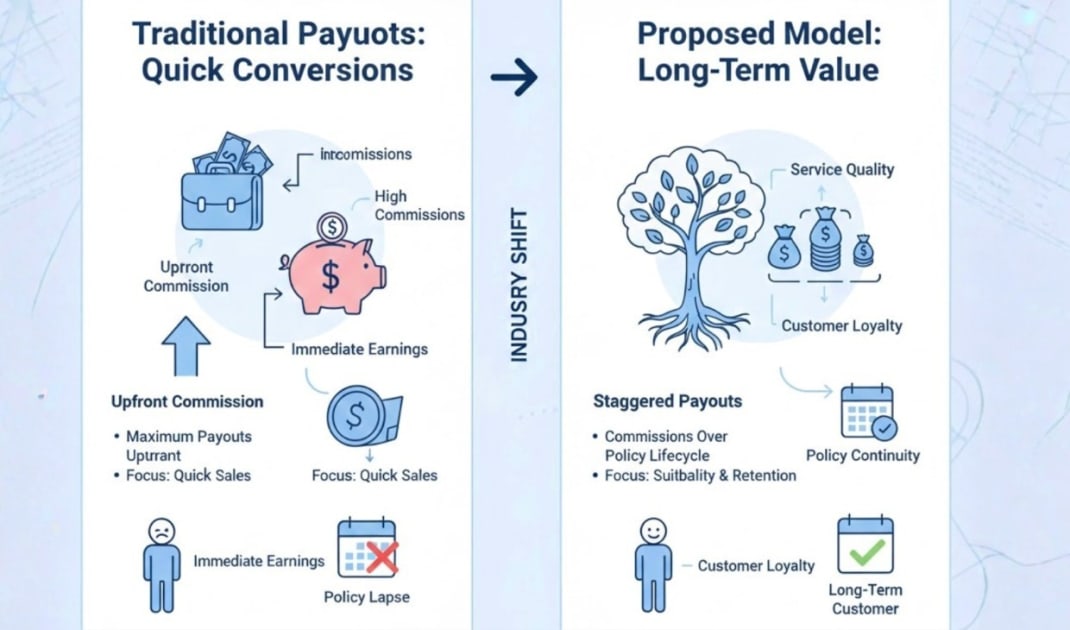
What Capping or Staggering Could Mean
Under the approaches currently being discussed:
Capping payouts would limit the maximum commission distributors can earn upfront
Staggered payouts would spread commissions over the policy lifecycle, rewarding long-term retention and servicing
Such structures encourage distributors to prioritise suitability, ongoing engagement, and policy continuity instead of quick conversions. Similar models already exist in other financial services segments, including mutual funds and wealth management, where long-term alignment has improved investor outcomes.
Impact on Insurers, Distributors, and Customers
If implemented, these reforms could have wide-ranging implications across the ecosystem.
For insurers
Improved persistency and renewal ratios
Reduced upfront cost pressure
Stronger alignment with regulatory and governance expectations
For distributors
Shift from transactional selling to relationship-driven advisory
More predictable, long-term income streams
Greater emphasis on service quality and trust
For customers
Lower risk of mis-selling
Products better aligned to long-term financial needs
Increased confidence in advisory quality and insurer intent
The Role of Data and Intelligent Systems
As payout structures evolve, insurers will increasingly rely on data-driven monitoring, AI-led risk assessment, and automated compliance systems to track distributor performance over time.
This is where modern enterprise platforms and intelligent frameworks become critical. Across India’s Global Capability Centre (GCC) ecosystem in Bengaluru, organisations are already exploring how AI-enabled systems can strengthen governance, transparency, and decision-making across highly regulated industries.
Initiatives supported by platforms such as SNS Square Bengaluru GCC reflect this shift toward responsible, technology-led transformation, helping institutions adapt to regulatory change without disrupting operational stability.
Looking Ahead: A More Balanced Insurance Ecosystem
The Life Insurance Council’s deliberations reflect a maturing industry that is placing greater emphasis on customer trust, distributor accountability, and long-term value creation. While implementation details will determine the ultimate impact, the direction is clear: growth must be sustainable and aligned with consumer confidence.
As India’s life insurance market continues to expand, structural reforms such as these will play a crucial role in shaping a more resilient, transparent, and customer-centric financial ecosystem.
Comments0
Please login to join the conversation
Be the first to comment!