
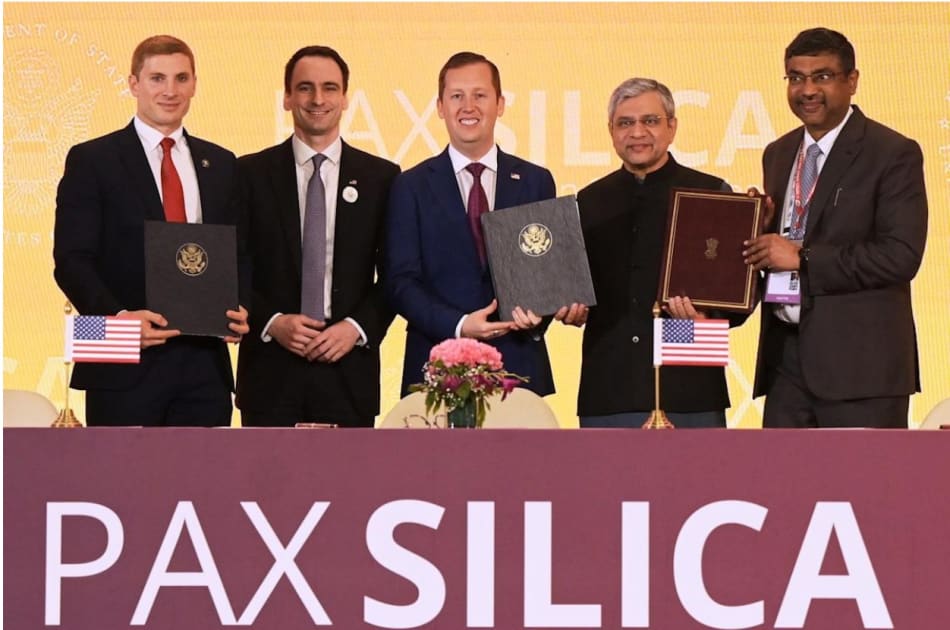
India’s entry into the U.S.-led Pax Silica initiative marks a significant shift in the global race to secure semiconductor and AI infrastructure supply chains. In 2026, access to advanced silicon technologies has become a critical driver of economic competitiveness, digital sovereignty, and technology leadership. The initiative aims to build a trusted network of partner nations capable of developing, sourcing, and distributing silicon-based technologies with greater resilience and security.
India joins a coalition that includes Japan, South Korea, Singapore, the Netherlands, Israel, the United Kingdom, Australia, Qatar, and the United Arab Emirates. Together, these countries represent a large share of the world’s advanced manufacturing capacity, innovation ecosystems, and AI infrastructure investments. For India, participation reinforces its role as both a major digital market and an emerging hub for advanced technology development.
Strategic Importance for AI Innovation and Digital Transformation
For organizations focused on AI innovation, digital transformation, and startup ecosystems, secure access to semiconductor supply is foundational. AI systems, cloud platforms, autonomous technologies, and next generation digital services all depend on reliable chip availability.
India’s inclusion in Pax Silica strengthens its ability to scale AI adoption across sectors such as healthcare, fintech, smart mobility, defense technology, and enterprise platforms. This momentum is particularly relevant for emerging innovation hubs and Global Capability Centres, including initiatives such as SNS Square Bengaluru GCC, which aim to accelerate enterprise AI deployment and digital transformation at scale.
Key implications for AI driven growth include:
• Faster deployment of advanced AI infrastructure across industries
• Stronger foundation for large scale digital transformation initiatives
• Increased attractiveness for multinational companies establishing GCCs in India
• Enhanced capacity to build and deploy Agentic AI solutions across sectors

Addressing Supply Chain Fragmentation and Risk
Modern semiconductor supply chains are highly complex and globally distributed. Production involves rare materials, specialized manufacturing equipment, advanced fabrication facilities, and precision logistics networks spread across multiple countries.
Recent disruptions exposed vulnerabilities in concentrated supply models. A single disruption can cascade across industries, delaying production of consumer electronics, electric vehicles, medical devices, and critical infrastructure systems.
Pax Silica focuses on diversification rather than concentration. By distributing manufacturing capacity and procurement pathways across trusted partners, the initiative aims to ensure continuity, reduce risk, and strengthen global technology resilience.
Critical resilience benefits include:
• Reduced dependence on a limited number of manufacturing locations
• Greater stability during geopolitical or economic disruptions
• Improved continuity for industries reliant on semiconductor supply
• Strengthened national technology security frameworks
Enabling Access to Advanced AI Hardware
A key element of the initiative is improving access to cutting edge AI semiconductors. The U.S. State Department has announced a pilot concierge service to help partner nations navigate procurement processes, regulatory approvals, and delivery timelines for advanced chips.
This mechanism leverages diplomatic networks to support governments and industry leaders in acquiring essential AI hardware efficiently. Simplified access can accelerate deployment of high performance computing systems, cloud infrastructure, and enterprise AI platforms.
For India, this could significantly boost domestic AI innovation, startup acceleration, data center expansion, and digital infrastructure development. Such progress directly supports the growth of advanced Agentic AI platforms, enabling organizations to transition from data driven insights to autonomous AI execution across business functions.
Potential innovation outcomes include:
• Expansion of high performance computing capabilities
• Acceleration of AI research and development initiatives
• Growth of data centers and cloud infrastructure
• Faster commercialization of AI powered products and services
Governance, Compliance, and Responsible Technology Use
Access to advanced AI chips carries significant economic and security implications. Transparent governance, regulatory compliance, and responsible technology use are essential to maintaining trust among participating nations.
Decisions about chip allocation, export controls, and technology sharing must balance economic growth with national security considerations. India’s participation reflects its strategic approach of collaborating globally while maintaining policy independence.
Key governance priorities include:
• Strong data protection and cybersecurity measures
• Clear regulatory oversight for advanced technology usage
• Transparent allocation mechanisms for critical hardware
• Ethical deployment of AI systems across industries
Implications for Startup Ecosystems and Innovation Platforms
Secure semiconductor supply chains are not only important for large enterprises but also for emerging startups. AI driven startups depend on affordable access to computing power, specialized hardware, and scalable cloud resources.
Participation in initiatives like Pax Silica can lower barriers to innovation by improving hardware availability and reducing uncertainty in procurement. This creates a more stable environment for entrepreneurs building products in areas such as generative AI, robotics, health technology, and advanced analytics.
Startup ecosystem benefits include:
• Reduced infrastructure constraints for early stage AI companies
• Faster prototyping and experimentation cycles
• Increased investor confidence in technology ventures
• Greater opportunities for global collaboration and market entry
Building a Resilient Technology Future
Pax Silica represents an effort to shape the technological architecture of the AI era. Control over semiconductor production and distribution will influence which nations lead future waves of digital transformation.
India’s entry positions it at the center of a trusted network designed to ensure reliable access to critical technologies. It opens opportunities for deeper collaboration in manufacturing, research, talent development, and infrastructure investment.
Long term strategic advantages include:
• Strengthened position in the global AI economy
• Enhanced capability to support large scale digital initiatives
• Attraction of foreign investment into advanced technology sectors
• Development of a robust and future ready innovation ecosystem
By the end of the decade, technological leadership may depend not only on software innovation but also on control of the hardware ecosystems that power AI. Nations that secure resilient supply chains today will shape the global digital economy of tomorrow.
In this context, India’s participation in Pax Silica reflects a strategic move toward long term competitiveness, innovation leadership, and sustainable growth in the AI driven world
Comments0
Please login to join the conversation
Be the first to comment!