
Introduction
Human Resources has traditionally been viewed as a support function responsible for recruitment, payroll, employee engagement, compliance, and workforce administration.
That model is changing.
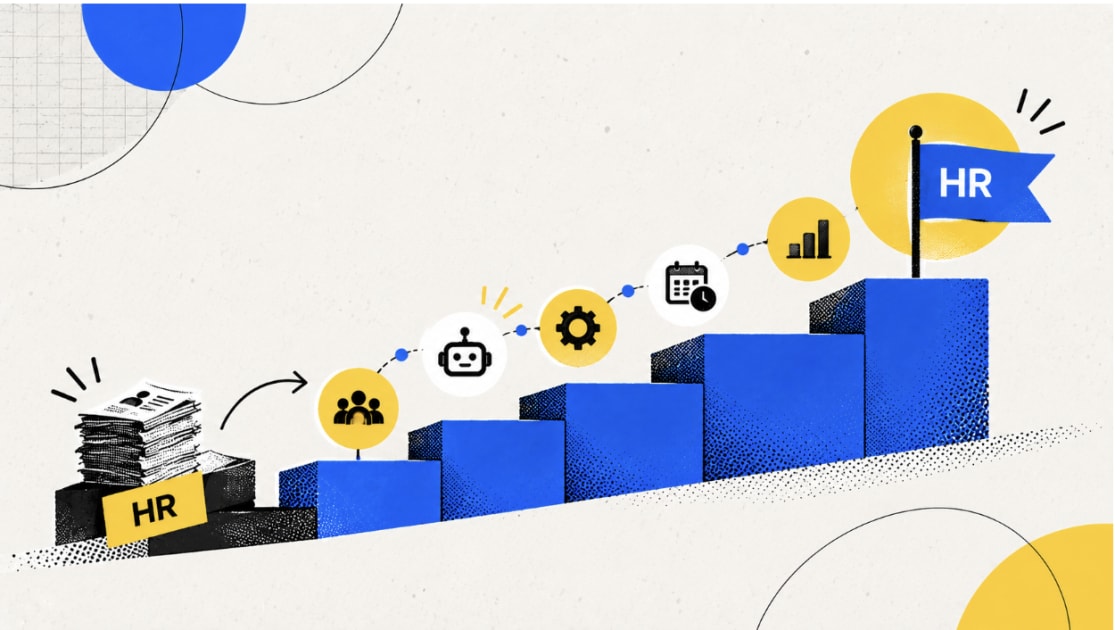
As organizations adopt AI across business functions, HR is increasingly becoming part of the enterprise's digital operating model. AI is helping HR teams move beyond administrative execution toward faster decision-making, workforce intelligence, personalized employee experiences, and continuous workforce planning.
The shift is not simply about automating HR tasks. It is about changing how HR operates.
From HR Administration to Workforce Intelligence
For years, HR systems primarily focused on storing employee information and managing workflows.
Recruitment platforms managed candidates. Payroll systems processed compensation. Learning platforms tracked training. Employee portals handled routine requests.
AI introduces a more intelligent layer across these systems.
Instead of simply recording information, AI can analyze workforce data to identify patterns, surface insights, and support decisions.
For example, organizations can use AI to understand:
Workforce skills and capability gaps
Recruitment trends
Employee support requirements
Workforce capacity
Learning and development needs
Payroll and administrative exceptions
Emerging workforce risks
This allows HR leaders to move from asking "What happened?" to understanding "What is changing, and what should we do next?"
AI Is Transforming the Employee Lifecycle
The employee lifecycle consists of numerous processes that traditionally require HR teams to coordinate across multiple systems.
AI can connect these experiences.
During recruitment, AI can assist with candidate screening, interview scheduling, communication, and job matching.
During onboarding, AI-powered assistants can help new employees find policies, complete documentation, understand organizational processes, and access relevant resources.
During employment, AI can support employees with HR queries, benefits information, workplace policies, and internal services.
At the same time, HR teams can use AI to identify workforce trends and improve employee support.
This creates a more connected employee experience rather than a collection of disconnected HR processes.
AI Agents Are Creating a New HR Operating Model
The next stage is the emergence of AI agents.
Unlike traditional automation that follows predefined workflows, AI agents can interact with enterprise systems, interpret information, and support multi-step processes within defined boundaries.
Consider an AI Employee Support Agent.
An employee could ask a question about leave, benefits, payroll, or company policies. The agent can understand the request, retrieve relevant information from approved systems, provide an answer, and escalate the issue when human intervention is required.
Similarly, a Recruitment Agent could support candidate coordination, interview scheduling, communication, and recruitment workflow management.
A Payroll Agent could help identify anomalies, respond to payroll-related questions, and support exception management.
These agents do not simply add another interface to HR systems. They can become an intelligent layer connecting employees, HR teams, and enterprise applications.
The Role of HR Is Expanding
As routine work becomes increasingly automated, HR's role can move toward more strategic responsibilities.
HR leaders can spend more time on questions such as:
What capabilities will the organization need next?
Where are the critical skill gaps emerging?
How should work change as AI adoption increases?
How can employees be prepared for new roles?
What workforce investments will support business growth?
This positions HR closer to business strategy.
The function becomes responsible not only for managing people processes but also for helping organizations understand how work itself is evolving.
Workforce Planning Becomes More Dynamic
Traditional workforce planning often relies on annual or periodic assessments.
AI enables a more continuous approach.
Organizations can combine workforce data with business demand, skills information, hiring trends, project requirements, and operational priorities to develop a more dynamic view of workforce needs.
For example, if a business is expanding its data and AI capabilities, HR can identify existing skills, determine capability gaps, evaluate internal mobility opportunities, and support targeted hiring or reskilling initiatives.
This creates a shift from reactive hiring to proactive workforce planning.
Human Expertise Remains Central
AI-enabled HR does not mean removing the human element from Human Resources.
Many HR decisions involve context, empathy, ethics, organizational culture, and individual circumstances.
AI can accelerate processes and provide insights, but human professionals remain important for sensitive decisions, employee relationships, organizational change, and strategic workforce leadership.
The emerging model is therefore not AI versus HR.
It is AI working alongside HR.
Technology handles scale, repetitive workflows, information retrieval, and analysis, while HR professionals focus on judgment, relationships, and strategic decisions.
Governance Becomes Essential
As AI becomes embedded into HR processes, organizations must establish appropriate governance.
HR systems contain sensitive employee information, making privacy, access control, security, transparency, and responsible AI practices particularly important.
Organizations should define:
What data AI systems can access
Which decisions require human approval
How AI-generated recommendations are reviewed
How employee information is protected
How system activity is monitored
How errors and exceptions are escalated
The objective is to create AI-enabled HR operations that are both efficient and responsible.
The Future of HR Is an Intelligent Operating Function
The evolution of HR is moving beyond isolated automation.
The combination of AI, enterprise data, workflow automation, and AI agents can create an HR function that continuously supports employees, assists HR professionals, and provides workforce intelligence to business leaders.
The organizations that benefit from this transformation will not simply automate individual HR tasks. They will rethink how the entire employee lifecycle operates.
The SNS Square Perspective
At SNS Square, we see AI-enabled HR as an opportunity to connect people, processes, data, and intelligent automation into a more responsive operating model.
From recruitment and onboarding to employee support, payroll, workforce intelligence, and HR service delivery, AI agents can help organizations streamline processes while enabling HR teams to focus on higher-value priorities.
The objective is not to replace the human side of HR.
It is to give HR the intelligence and automation needed to operate at enterprise scale.
Conclusion
HR is entering a new phase.
AI is transforming the function from a primarily administrative and support-oriented role into an increasingly intelligent, data-driven, and business-connected operating function.
The question is no longer whether AI will influence HR.
It is how organizations will redesign HR around the possibilities created by intelligent systems.
The future of HR is not just about managing the workforce. It is about intelligently enabling the workforce and shaping how work gets done.
Comments0
Please login to join the conversation
Be the first to comment!