
Introduction
Setting up a Global Capability Center (GCC) in India is an important step for global enterprises looking to expand their technology capabilities, strengthen global operations, and access a highly skilled workforce. However, establishing the center is only the beginning. One of the most critical challenges comes next: building the first 50–100 employees who will shape its capabilities, culture, and future direction.
The initial hiring phase has a lasting influence on how a GCC operates. The first employees establish working practices, build relationships with global headquarters, define delivery standards, and create the foundation for future teams.
Hiring too quickly can lead to mismatched capabilities and organizational complexity. Hiring too slowly can delay operations and weaken confidence among global stakeholders.
The challenge is not simply filling 100 positions. It is identifying the right combination of leadership, technical expertise, operational capabilities, and organizational talent to build a center that can grow with the enterprise.
1. Define the GCC's Purpose Before Starting Recruitment
Before opening recruitment positions, enterprises must establish what the GCC is expected to accomplish.
A center focused on technology support will require a different workforce from one responsible for product engineering, data science, AI development, or global business operations.
The hiring strategy should therefore begin with a clearly defined GCC mandate.
Key questions include:
Which business functions will the GCC initially support?
Will the center focus on technology delivery, product ownership, innovation, or business operations?
Which capabilities must be available from the first day?
What responsibilities will remain with global headquarters?
How is the GCC expected to evolve over the next three years?
For example, a GCC established to develop enterprise AI capabilities may need data engineers, AI engineers, cloud architects, platform specialists, and governance professionals.
A center focused on financial operations may require expertise in banking processes, risk management, compliance, analytics, and enterprise technology.
The mandate determines the workforce structure, hiring priorities, leadership requirements, and investment needed to establish the center.
2. Hire the Leadership Team Before Scaling Recruitment
The first major hiring decision should not necessarily be about the number of employees. It should be about who will lead them.
A GCC needs leadership that can connect local operations with global business objectives. The center head must understand the enterprise's priorities, establish relationships with headquarters, and build an organization capable of taking ownership over time.
Depending on the GCC's mandate, early leadership appointments may include:
GCC Head or Site Leader
Technology or Engineering Head
HR and Talent Acquisition Lead
Finance and Administration Lead
Operations or Delivery Head
Data and AI Leadership, where relevant
Not every GCC needs to hire all these positions immediately. The leadership structure should reflect the center's size, responsibilities, and operating model.
The first leaders should also be capable of recruiting and developing their own teams. Their ability to attract strong professionals, establish expectations, and create a collaborative culture will influence the quality of subsequent hiring.
3. Build a Phased Hiring Plan for the First 50–100 Employees
Recruiting 100 employees as one large hiring exercise can create unnecessary pressure on talent acquisition teams and increase the risk of hiring mismatches.
A phased approach allows the GCC to establish its operating foundation before expanding its workforce.
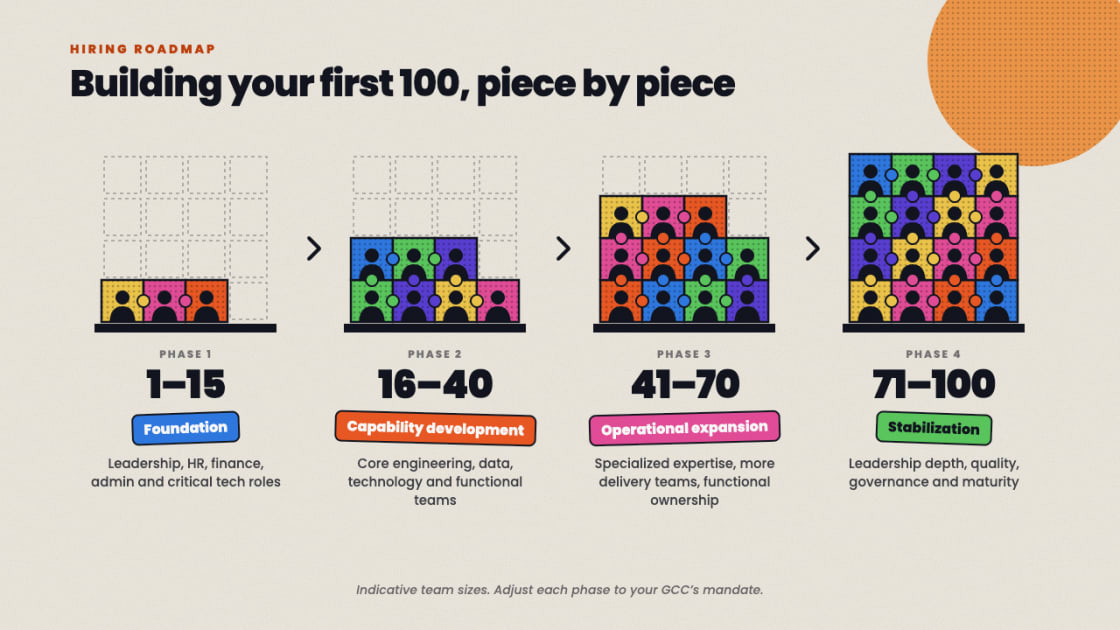
An illustrative hiring structure could look like this:
Hiring phaseTarget team sizePrimary objectivePhase 1: Foundation1–15Leadership, HR, finance, administration, and critical technical rolesPhase 2: Capability development16–40Core engineering, data, technology, and functional teamsPhase 3: Operational expansion41–70Specialized expertise, additional delivery teams, and functional ownershipPhase 4: Stabilization71–100Leadership depth, quality, governance, and operational maturity
The numbers are indicative and should be adjusted according to the GCC's business mandate.
The important principle is sequencing. Early hires should establish the capabilities needed to recruit, onboard, manage, and support the next group of employees.
This creates a more controlled expansion process and helps the center build operational maturity alongside headcount.
4. Hire for Capability, Not Just Job Titles
A common recruitment challenge is relying too heavily on conventional job descriptions.
Two candidates with the same job title may have very different levels of technical depth, business understanding, problem-solving ability, and experience working with global teams.
GCCs should evaluate candidates based on the capabilities required to fulfil the center's mandate.
For technology-focused GCCs, this may include:
Engineering capabilities: Software development, application architecture, platform engineering, testing, and DevOps.
Data and AI capabilities: Data engineering, machine learning, AI engineering, analytics, model evaluation, and data governance.
Cloud and infrastructure capabilities: Cloud architecture, cybersecurity, infrastructure management, and enterprise integration.
Business and functional capabilities: Product management, finance operations, procurement, customer experience, and domain expertise.
Leadership and collaboration capabilities: Stakeholder management, communication, decision-making, and cross-functional coordination.
Technical assessments should be combined with practical problem-solving exercises and evaluations of how candidates approach real business challenges.
This helps identify professionals who can contribute to the GCC's long-term objectives rather than simply match a list of qualifications.
5. Build the Right Mix of Experienced and Emerging Talent
The first 50–100 employees should not consist entirely of senior professionals or entry-level hires.
An effective GCC needs a balanced workforce.
Experienced professionals bring technical expertise, domain knowledge, leadership, and the ability to establish working standards. Mid-level professionals provide execution capability and help build functional teams. Emerging talent offers opportunities to develop future capabilities through structured learning and mentorship.
A balanced hiring strategy can help GCCs:
Establish technical and operational leadership early.
Build teams that can execute projects independently.
Develop internal talent pipelines.
Reduce excessive dependence on external hiring.
Create opportunities for knowledge transfer and succession planning.
The exact mix depends on the complexity of the GCC's responsibilities and the availability of specialized skills in the market.
For emerging technology functions such as Agentic AI, cloud engineering, and advanced analytics, organizations may need to combine experienced specialists with structured upskilling initiatives.
6. Choose the Right Location and Understand the Talent Market
India offers several established technology ecosystems, each with different strengths in talent availability, infrastructure, industry presence, and operating costs.
Cities such as Bengaluru, Hyderabad, Chennai, Pune, and Coimbatore offer different advantages for GCC expansion.
Location selection should be based on the capabilities the enterprise needs rather than cost considerations alone.
Important factors include:
Availability of specialized technology professionals.
Presence of relevant industry and technology ecosystems.
Competition for experienced talent.
Office infrastructure and connectivity.
Access to leadership and functional talent.
Long-term workforce expansion potential.
For example, a GCC focused on advanced engineering and AI may prioritize access to specialized technology communities. An organization building a large operations center may place greater emphasis on workforce availability, infrastructure, and scalability.
A location strategy should also consider whether the center can attract and retain talent as it expands beyond its initial hiring target.
7. Create an Employer Proposition That Attracts the Right Talent
A newly established GCC may not have the brand recognition of a well-known technology company or an established multinational employer.
This makes its employer proposition particularly important.
Candidates need to understand why they should join a new center and what opportunities it can offer.
A compelling proposition should communicate:
The global importance of the work being undertaken.
Opportunities to work with modern enterprise technologies.
Access to international teams and leadership.
Career progression and technical learning opportunities.
Ownership of meaningful products, platforms, and business processes.
A workplace culture built around collaboration and innovation.
GCCs should also communicate how roles may evolve as the center grows.
Professionals are more likely to consider a new organization when they can see opportunities to contribute, develop expertise, and take on greater responsibility.
8. Make Onboarding and Knowledge Transfer Part of the Hiring Strategy
Recruitment does not end when a candidate accepts an offer.
The first employees must understand the parent organization's business, technology environment, operating practices, and expectations.
Without a structured onboarding process, even highly experienced professionals may take considerable time to become productive.
A strong onboarding framework should include:
Business orientation: Introduce employees to the parent company's products, customers, operating model, and strategic priorities.
Technical orientation: Provide access to relevant platforms, tools, documentation, systems, and development environments.
Role clarity: Define responsibilities, reporting structures, decision-making authority, and performance expectations.
Knowledge transfer: Establish structured interactions with headquarters and existing global teams.
Cultural integration: Help employees understand communication practices, collaboration expectations, and ways of working across locations.
AI-powered knowledge platforms can further support onboarding by helping employees retrieve approved documentation, locate relevant processes, and access organizational knowledge.
The objective is to help new employees become effective contributors rather than simply complete an induction programme.
9. Establish the Operating Model Before the GCC Scales
As the GCC approaches its first 100 employees, informal processes that worked during the initial setup may become difficult to manage.
Organizations need to establish consistent operating practices across recruitment, delivery, performance management, technology governance, and communication with headquarters.
This includes defining:
Reporting structures and functional ownership.
Project allocation and delivery processes.
Performance measurement and review mechanisms.
Security and compliance requirements.
Knowledge management practices.
Collaboration and escalation procedures.
For technology-focused centers, architecture standards, development practices, data access controls, and AI governance should be introduced early.
Building these foundations during the initial hiring phase reduces the need for major organizational restructuring as the center expands.
10. Measure the Success of the First 100 Hires
The success of a GCC's initial workforce should not be measured only by the number of positions filled.
Organizations need to assess whether the right capabilities have been established and whether the center is becoming operationally effective.
Useful indicators include:
Time to fill critical positions.
Quality of hire and role readiness.
Employee retention during the first year.
Time taken for new employees to become productive.
Internal mobility and capability development.
Project delivery performance.
Knowledge transfer completion.
Employee engagement and leadership effectiveness.
These indicators provide a clearer understanding of whether recruitment is contributing to the GCC's long-term business objectives.
The first 100 employees should create a foundation for sustainable growth, not just satisfy an initial headcount target.
How SNS Square Supports the Evolution of GCC Capabilities
Building a GCC requires alignment between workforce strategy, technology capabilities, enterprise integration, and operational readiness.
SNS Square focuses on Data and Agentic AI, intelligent automation, and enterprise technology capabilities that support the changing requirements of global organizations.
Through its Agentic Workbench approach, enterprises can explore coordinated AI workflows, data foundations, orchestration, integration, and governance to support modern technology operations.
As GCCs expand into AI engineering, intelligent automation, and enterprise transformation, these capabilities can help organizations define the technology environment and specialized expertise required for their next stage of growth.
The broader objective is to build GCCs that move beyond initial delivery requirements towards sustained technology ownership and measurable enterprise value.
Conclusion
Hiring the first 50–100 employees for a GCC in India is not simply a recruitment exercise. It is the process of establishing the people, capabilities, and operating culture that will define the center's future.
A clear business mandate, strong initial leadership, phased recruitment, balanced talent composition, structured onboarding, and an effective operating model are essential to building a successful foundation.
As GCCs take on greater responsibility for AI, product engineering, data, and enterprise transformation, the quality of their initial workforce will become even more important.
The strongest GCCs will not necessarily be the ones that hire the fastest. They will be the ones that build the right capabilities in the right sequence and create an organization prepared to grow with the global enterprise.
Comments0
Please login to join the conversation
Be the first to comment!