
Introduction
India has become a strategic destination for Global Capability Centers (GCCs), attracting global enterprises looking to build technology capabilities, accelerate innovation, and strengthen their global operations. As GCCs expand beyond traditional support functions into product engineering, data science, cybersecurity, cloud computing, and Agentic AI, their talent requirements are becoming increasingly specialized.
However, establishing a GCC in India is only one part of the challenge. Building a workforce with the right capabilities, retaining experienced professionals, and creating an environment where talent can grow are equally important.
Technology professionals today evaluate opportunities beyond compensation. They consider the complexity of the work, access to emerging technologies, career progression, leadership opportunities, workplace flexibility, and the opportunity to contribute to meaningful business outcomes.
For GCCs, attracting and retaining top talent requires a shift from recruitment-driven growth to a long-term talent development strategy.
1. Build a Strong Employer Value Proposition
In a competitive technology market, salary alone is rarely enough to differentiate an employer. GCCs need to communicate what makes their work environment and career opportunities distinctive.
Professionals increasingly look for opportunities to work on global products, solve complex engineering challenges, influence business decisions, and contribute to technology initiatives that reach international markets.
A strong employer value proposition should highlight:
Opportunities to work on global products and enterprise technology initiatives.
Exposure to emerging technologies such as AI, cloud, data engineering, and automation.
Access to international teams and leadership.
Clear career development and internal mobility pathways.
A workplace culture that encourages ownership, collaboration, and innovation.
GCCs that position themselves as centers of innovation rather than purely execution-focused operations can create a stronger proposition for experienced technology professionals.
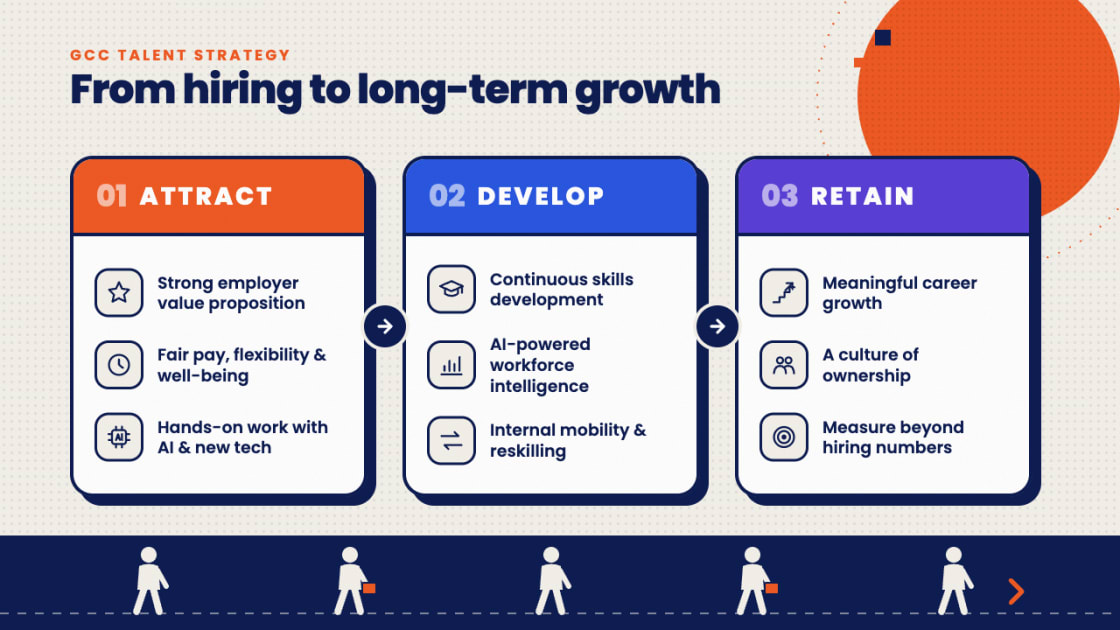
2. Invest in Continuous Skills Development
Technology capabilities evolve faster than traditional workforce planning cycles. Skills that are in high demand today may change as organizations adopt new platforms, automation technologies, and AI-driven operating models.
For GCCs, hiring every emerging skill externally is neither sustainable nor sufficient. Developing existing employees is equally important.
Organizations should establish continuous learning initiatives that connect individual development with future business requirements.
For example, software engineers can develop expertise in AI engineering, cloud-native development, and intelligent automation. Data professionals can expand into data governance, machine learning operations, and enterprise analytics. Cybersecurity teams can strengthen capabilities in AI security and threat intelligence.
AI-powered skills intelligence can further support this process by identifying existing capabilities, highlighting emerging skill gaps, and helping organizations plan targeted learning pathways.
When employees can see how their skills will evolve alongside the organization, learning becomes part of career progression rather than an occasional training activity.
3. Create Meaningful Career Growth Opportunities
One of the challenges GCCs face is retaining experienced professionals who want opportunities to move beyond their current roles.
Employees may leave when they see limited opportunities for advancement, restricted decision-making authority, or repetitive work that does not allow them to develop new capabilities.
GCCs can address this by creating career pathways that extend beyond conventional reporting structures.
This includes opportunities to:
Move between engineering, product development, data, and technology leadership roles.
Participate in global transformation projects.
Lead specialized technical teams and Centres of Excellence.
Contribute to architecture and enterprise technology decisions.
Explore international assignments and cross-functional responsibilities.
Career growth should not be limited to promotions. Access to more complex responsibilities, technical ownership, and opportunities to influence business outcomes can also strengthen employee engagement.
4. Make AI and Emerging Technologies Part of the Employee Experience
The growing adoption of AI is changing both the skills organizations need and the expectations employees have from their workplace.
Technology professionals increasingly want exposure to modern tools, intelligent platforms, and opportunities to solve problems using emerging technologies.
For GCCs, this creates an opportunity to make AI adoption part of their talent strategy.
Rather than introducing AI only as a productivity initiative, organizations can provide employees with opportunities to work on AI-enabled products, build intelligent workflows, experiment with automation, and develop expertise in multi-agent systems.
This can also help employees transition into emerging roles involving AI orchestration, model evaluation, data governance, and enterprise automation.
However, technology adoption must be supported by appropriate training, clear responsibilities, and opportunities for employees to apply what they learn.
A workplace that invests in its people's ability to work alongside AI is better positioned to develop capabilities for the next phase of enterprise transformation.
5. Build a Culture of Ownership and Collaboration
As GCCs take on more strategic responsibilities, employees need opportunities to contribute beyond assigned tasks.
A culture of ownership encourages professionals to identify problems, propose improvements, take responsibility for outcomes, and collaborate with global stakeholders.
This becomes particularly important in distributed organizations where teams work across locations and time zones.
GCC leaders can strengthen this culture by:
Giving teams greater ownership of projects and deliverables.
Encouraging collaboration between global business units.
Creating transparent communication channels with enterprise leadership.
Recognizing innovation and problem-solving contributions.
Building cross-functional teams around business outcomes.
Employees are more likely to feel connected to the organization when they understand how their work contributes to larger enterprise goals.
6. Rethink Compensation, Flexibility, and Employee Well-Being
Compensation remains an important factor in attracting and retaining technology talent, particularly in competitive hiring markets. However, a sustainable talent strategy must consider the complete employee experience.
Flexible working arrangements, supportive managers, manageable workloads, transparent performance expectations, and meaningful recognition all influence retention.
GCCs should regularly evaluate compensation structures against relevant talent markets while also examining employee feedback, workload patterns, and opportunities for greater workplace flexibility.
Well-being should not be treated as a standalone HR initiative. It is closely connected to how teams are structured, how work is distributed, and how leadership responds to employee needs.
Organizations that create supportive working environments can strengthen their ability to attract experienced professionals and retain institutional knowledge.
7. Use Workforce Intelligence to Anticipate Talent Needs
Traditional recruitment planning often begins when a team identifies an immediate shortage. By then, the business may already be experiencing delivery pressure.
GCCs need a more forward-looking approach that connects business expansion plans with workforce capabilities.
AI-powered workforce analytics can help organizations understand current skill distribution, identify potential capability gaps, analyze internal mobility opportunities, and forecast future talent requirements.
For example, a GCC preparing to expand its Agentic AI capabilities may need additional expertise in data engineering, AI security, workflow orchestration, and model evaluation.
By identifying these requirements early, organizations can decide which capabilities to build internally, where targeted hiring is necessary, and which employees could benefit from reskilling.
This approach helps align recruitment, learning and development, and business strategy around a shared view of future workforce needs.
8. Measure Talent Strategy Beyond Hiring Numbers
A successful GCC talent strategy should not be evaluated only by the number of employees recruited or positions filled.
Organizations need to understand whether they are developing the capabilities required for long-term growth and creating an environment where experienced professionals choose to stay.
Important indicators include:
Employee retention and voluntary attrition.
Time to fill critical technology roles.
Internal mobility and promotion rates.
Learning participation and skills development.
Employee engagement and satisfaction.
Representation of local leadership in strategic roles.
Workforce readiness for emerging technology requirements.
Tracking these indicators together provides a more complete understanding of talent strategy effectiveness and helps leaders identify where improvements are needed.
How SNS Square Fits Into the Future of GCC Talent
Building a future-ready GCC requires more than access to technology professionals. It requires an environment where people, technology, and business priorities evolve together.
SNS Square's focus on Data and Agentic AI, intelligent automation, and enterprise technology capabilities reflects the growing importance of specialized skills in modern GCC operations.
Through its Agentic Workbench approach, organizations can explore AI-driven workflows and enterprise capabilities that create opportunities for professionals to work on intelligent systems, connected applications, and complex business challenges.
As GCCs expand their technology mandates, the ability to develop specialized talent, encourage ownership, and connect workforce capabilities with enterprise objectives will become increasingly important.
Conclusion
India's GCC landscape is evolving from a model focused primarily on operational scale to one increasingly centered on innovation, technology ownership, and enterprise transformation.
Attracting top technology talent requires a compelling employer proposition, while retaining that talent depends on continuous learning, meaningful career opportunities, supportive leadership, and a culture of ownership.
As AI reshapes the nature of technology work, GCCs must also rethink how they identify, develop, and deploy workforce capabilities.
The GCCs that build lasting talent strategies will be those that invest not only in recruiting skilled professionals, but also in creating an environment where people can learn, contribute, lead, and grow alongside the organization.
Comments0
Please login to join the conversation
Be the first to comment!