

Global supply chains are undergoing one of the most profound transformations in decades. Volatility driven by geopolitics, climate disruptions, logistics bottlenecks, and post-pandemic shocks has exposed the limits of traditional just-in-time models. In this environment, reacting to disruptions is no longer enough. Competitive advantage now belongs to organizations that can anticipate risk, simulate outcomes, and act before disruption materialises.
Artificial intelligence is at the centre of this shift, enabling supply chains to move from reactive execution to predictive and prescriptive orchestration.
Predictive Orchestration Replaces Siloed Planning
For years, procurement, manufacturing, and logistics operated as independent silos, each relying on separate systems and delayed data. That model is rapidly being replaced by AI-powered control towers that unify enterprise-wide data into a single, intelligent view.
Predictive orchestration allows organisations to ingest internal data alongside external signals such as weather patterns, port congestion, geopolitical events, and market sentiment. Machine learning models then forecast potential disruptions and recommend proactive responses.
This approach aligns closely with how Global Capability Centre (GCC) models in Bengaluru are evolving, particularly those focused on Data to Agentic AI transformation, where integrated intelligence replaces fragmented decision-making.
Generative AI and Digital Twins Move from Experimentation to Operations
Generative AI is no longer confined to pilots or innovation labs. It is becoming a core operational tool in global supply chains.
By combining generative AI with digital twins, enterprises can now simulate thousands of “what-if” scenarios across their supply networks. These simulations help leaders stress-test supply chains against supplier failures, transport delays, demand spikes, or regulatory changes.
Instead of reviewing safety stock annually, AI enables continuous optimisation, identifying single-source dependencies and dynamically adjusting inventory levels in real time. This transition reflects a broader move toward agentic systems, where AI does not just analyse data but actively supports decision execution.
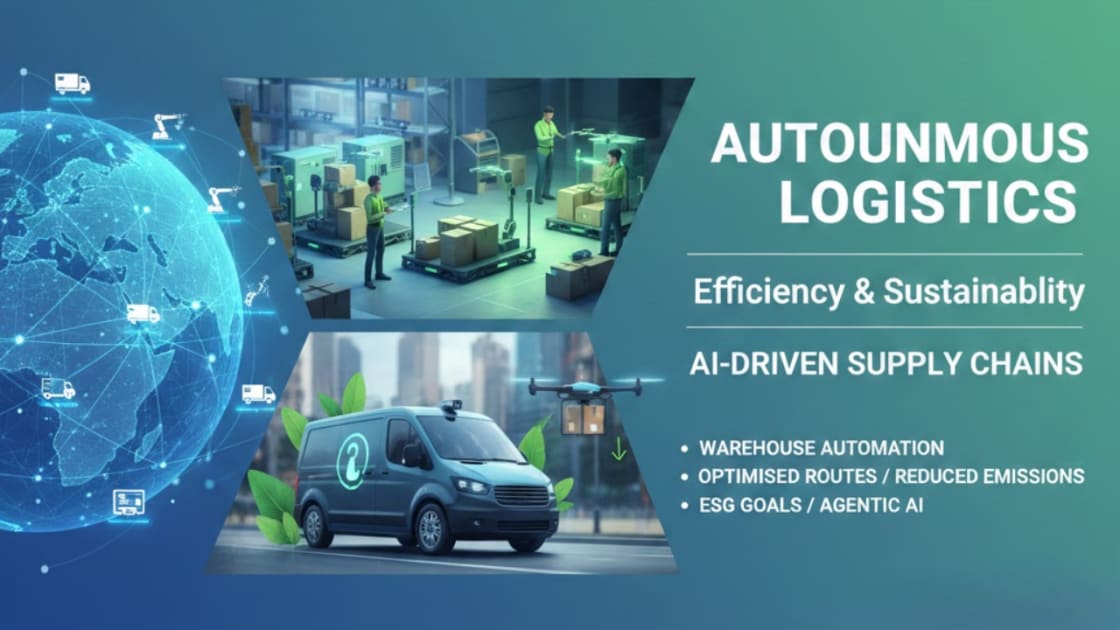
Autonomous Logistics Improves Efficiency and Sustainability
Logistics, particularly the last mile, has historically been one of the most complex and expensive components of the supply chain. AI-driven routing, autonomous mobile robots, and computer vision are now redefining efficiency at both warehouse and transportation levels.
Within fulfilment centres, autonomous systems have evolved from rule-based automation to adaptive agents capable of navigating dynamic human environments. At a network level, AI is enabling optimisation of the physical internet, where standardised containers move across shared routes with minimal empty miles.
Beyond cost reduction, these capabilities are increasingly tied to ESG goals. AI-led route optimisation reduces fuel consumption, lowers emissions, and supports sustainability commitments, an area of growing focus for enterprises building agentic AI-enabled supply chain platforms.
Human-in-the-Loop Remains Central
Despite rising automation, the future of supply chains is not human-less. The most effective AI implementations follow a human-in-the-loop model, where AI handles scale and complexity, while humans provide strategic judgment and relationship leadership.
As AI manages routine execution and flags anomalies, supply chain professionals are shifting toward exception management, strategic oversight, and ecosystem coordination. This transition requires significant upskilling, moving roles away from tactical execution toward higher-order decision-making.
This evolution mirrors how AI-native GCCs are being designed, especially in innovation hubs like Bengaluru, where talent models increasingly focus on orchestration, governance, and enterprise alignment rather than task execution alone.
Data Integrity and Cybersecurity Become Strategic Priorities
AI is only as effective as the data that feeds it. Inconsistent, unverified, or compromised data can undermine even the most advanced systems.
As supply chains become more software-defined, attack surfaces expand. In response, enterprises are investing in data clean rooms, blockchain-based provenance systems, and AI-driven security monitoring to ensure data authenticity and prevent both cyber and physical risks such as cargo theft.
AI for security is emerging as a parallel capability, using predictive analytics to identify anomalies before incidents escalate.
Toward the Intelligent, Self-Healing Supply Chain
The integration of AI into global supply chains is not merely a technology upgrade. It represents a structural evolution toward intelligent, self-healing enterprises.
Future supply chains will not only detect issues but autonomously respond by rerouting shipments, switching suppliers, or dynamically adjusting pricing and inventory. Human oversight will remain critical, but the operational backbone will be predictive, adaptive, and continuously learning.
For enterprises building next-generation supply chains, the goal is clear: move beyond visibility toward anticipation, resilience, and intelligent action. This is the foundation of the predictive supply chain era, and it is already reshaping how global trade operates.
Comments0
Please login to join the conversation
Be the first to comment!