

The fashion industry is undergoing a quiet but fundamental shift. While creativity and aesthetics remain at its core, the processes that support design, production, and distribution are being reengineered through artificial intelligence. From trend forecasting to inventory planning, AI is addressing long-standing inefficiencies that have shaped the industry for decades.
What was once driven by intuition, seasonal assumptions, and long lead times is becoming data-informed, adaptive, and significantly more responsive to real-world demand.
Artificial intelligence is emerging as a practical enabler of this transformation.
Across fashion brands, manufacturers, and retailers, AI-powered systems are being deployed to analyse consumer behaviour, optimise supply chains, and streamline design workflows. These systems help teams move faster, reduce waste, and align creativity more closely with commercial reality.

Why the Traditional Fashion Supply Chain Was Strained
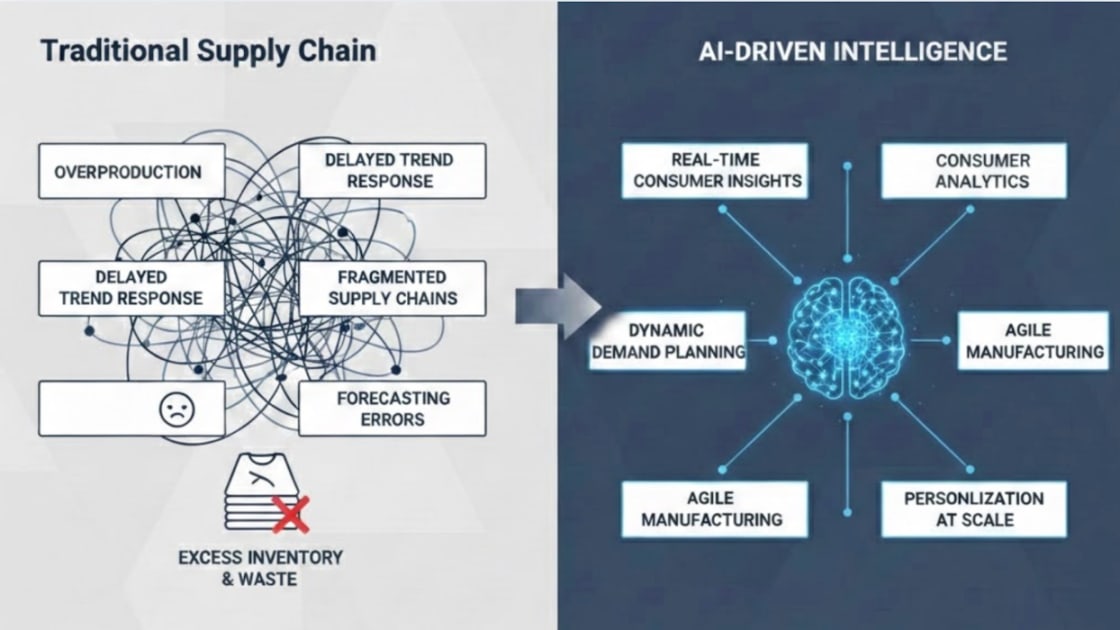
Fashion has historically struggled with overproduction, delayed trend response, and fragmented supply chains. Designers often worked months in advance with limited visibility into real-time consumer preferences. Supply chain decisions relied heavily on forecasts that could not adapt quickly to shifting demand, leading to excess inventory, markdowns, and environmental waste.
As collection cycles shortened and consumer expectations shifted toward personalisation and speed, these structural limitations became increasingly difficult to sustain.
AI addresses this challenge by replacing static planning models with dynamic, data-driven intelligence.
How AI Is Changing Everyday Fashion Operations
Modern AI systems are now being applied across multiple stages of the fashion lifecycle:
Analysing social media signals, search behaviour, and purchase data to detect emerging trends early
Supporting designers by generating design variations, visual concepts, and inspiration inputs
Improving demand forecasting to reduce overproduction and inventory risk
Optimising supplier coordination, logistics, and inventory allocation across regions
Instead of relying solely on historical data or manual forecasting, teams now work with AI-generated insights that continuously adapt as market conditions change. This enables fashion brands to respond faster while reducing operational friction.
From Automation to Context-Aware Decision Support
The real transformation is not automation alone, but context awareness. AI systems in fashion are increasingly capable of interpreting consumer behaviour patterns, regional preferences, and supply constraints together.
This marks a shift from task-level automation to intelligent decision support where AI informs what to design, how much to produce, and where to allocate resources.
Similar Agentic AI platforms are being explored across enterprise ecosystems, including initiatives emerging from SNS Square Bengaluru GCC, where organisations focus on moving from data-driven insights to context-aware decision-making across complex supply networks.
Impact on Sustainability and Business Outcomes
One of the most significant outcomes of AI adoption in fashion is sustainability. By aligning production more closely with actual demand, AI reduces excess inventory, material waste, and unnecessary transportation.
Fashion brands adopting AI-driven planning are beginning to see:
Lower inventory holding costs
Reduced dependency on markdowns
Faster speed-to-market
Better alignment between creative vision and commercial performance
In this model, sustainability becomes the outcome of better decisions rather than an afterthought.
A Broader Industry Shift Toward Intelligent Systems
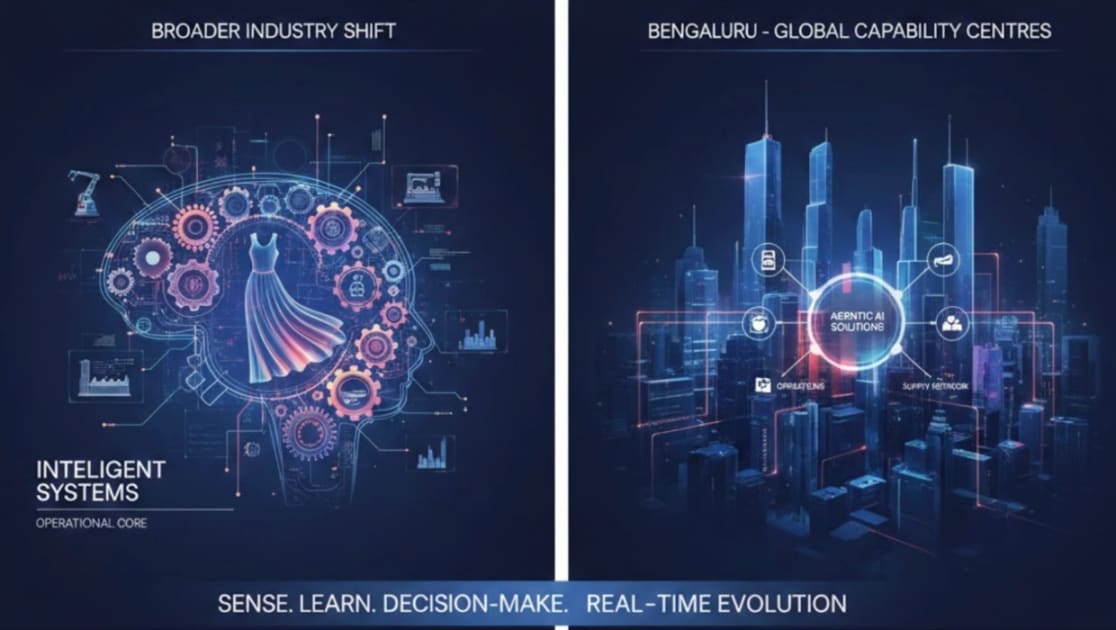
What is unfolding in fashion reflects a wider transformation across industries. AI is no longer positioned as a supporting tool; it is becoming part of the operational core. Systems are being designed to sense change, learn continuously, and support decision-making in real time.
This evolution mirrors how Global Capability Centres (GCCs) in Bengaluru are being reimagined, shifting from execution-heavy models toward Agentic AI solutions that operate across design, operations, and supply ecosystems.
Looking Ahead
AI will not replace designers, planners, or supply chain professionals. Instead, it reduces friction in their workflows, allowing them to focus on creativity, strategy, and innovation.
As AI becomes more deeply integrated into fashion ecosystems, success will depend on thoughtful implementation, strong data foundations, and responsible use. When applied well, AI enables the fashion industry to become more responsive, more sustainable, and more resilient in an increasingly unpredictable market.
The future of fashion is not defined only by what is created, but by how intelligently it is created and delivered.
Comments0
Please login to join the conversation
Be the first to comment!