
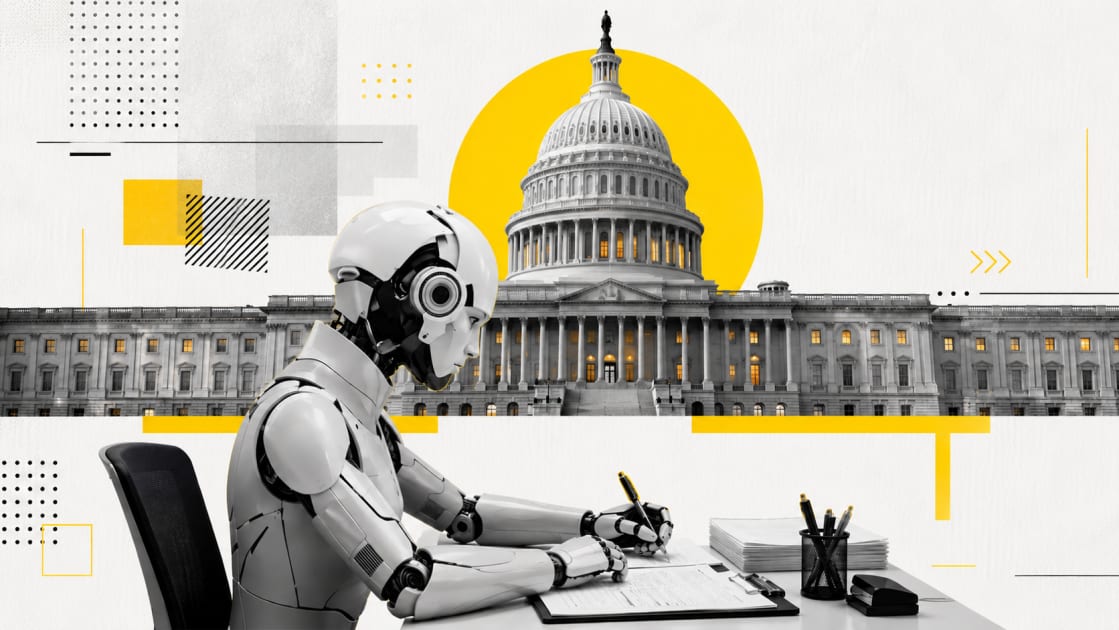
Government agencies today face increasing pressure to deliver faster services, improve citizen experiences, and operate more efficiently, all while managing budget constraints, staffing shortages, and growing compliance requirements.
From permit approvals and benefits administration to procurement management and document processing, public sector organizations handle thousands of repetitive, time-consuming workflows every day. These manual processes often create bottlenecks that slow service delivery, increase operational costs, and frustrate both employees and citizens.
Artificial Intelligence (AI) and automation are changing that reality.
Across federal, state, local, and education (SLED) organizations, agencies are leveraging AI-powered workflow automation, robotic process automation (RPA), and intelligent document processing solutions to streamline operations and dramatically reduce processing times.
In many cases, organizations are achieving reductions of up to 70% in workflow processing time while improving accuracy, compliance, and citizen satisfaction.
As digital transformation accelerates in 2026, AI and automation are becoming essential tools for modern government operations.
Why Government Workflows Need Modernization
Many public sector processes still rely heavily on manual tasks.
Employees spend significant time:
Reviewing documents
Entering data
Routing approvals
Processing applications
Responding to inquiries
Managing compliance records
Tracking procurement activities
These repetitive tasks consume valuable resources and often lead to delays.
As workloads increase and staffing challenges continue, manual operations become increasingly difficult to sustain.
Government workflow automation helps agencies eliminate inefficiencies by enabling systems to handle routine activities automatically while allowing employees to focus on higher-value work.
What Is Government Workflow Automation?
Government workflow automation uses technologies such as AI, machine learning, and robotic process automation (RPA) to streamline and optimize business processes.
Instead of requiring manual intervention at every stage, automated workflows can:
Collect information
Validate submissions
Process documents
Route approvals
Trigger notifications
Generate reports
Monitor compliance
The result is faster, more consistent, and more scalable operations.
Unlike traditional automation, modern AI-powered systems can analyze context, make recommendations, identify anomalies, and continuously improve performance over time.
Use Case #1: Permit Approval Automation
Permit and licensing processes are among the most common areas where government agencies experience delays.
Applications often require multiple reviews, document verification, interdepartmental coordination, and manual approvals.
This can result in processing times that stretch from days into weeks.
How AI Improves Permit Processing
AI-powered systems can automatically:
Review submitted applications
Verify required documentation
Identify missing information
Validate compliance requirements
Route requests to appropriate departments
Provide real-time status updates
Instead of spending hours manually reviewing every submission, staff can focus only on exceptions that require human judgment.
The result is significantly faster approvals, improved transparency, and better service for citizens and businesses.
Use Case #2: Benefits Processing & Eligibility Verification
Government agencies responsible for benefits administration often manage enormous volumes of applications and supporting documentation.
Manual reviews can create backlogs that delay critical services for eligible recipients.
How AI Accelerates Benefits Administration
Intelligent automation platforms can:
Extract information from forms
Verify applicant data
Validate supporting documentation
Flag inconsistencies
Route cases for review
Communicate status updates automatically
This helps agencies process applications more efficiently while reducing human error and improving compliance.
Citizens receive faster decisions, and staff spend less time on repetitive administrative tasks.
Use Case #3: Procurement Automation
Government procurement is essential to public sector operations, but it is also one of the most document-intensive and compliance-driven functions.
Procurement teams often spend significant time managing:
Vendor registration
Bid evaluations
Contract reviews
Compliance checks
Approval workflows
Reporting requirements
These manual processes can delay project execution and increase administrative burden.
How AI Supports Procurement Teams
AI and automation can help agencies:
Analyze procurement documents
Evaluate vendor responses
Identify contract risks
Monitor compliance requirements
Automate approval routing
Generate audit-ready reports
By streamlining procurement workflows, agencies can accelerate purchasing cycles while maintaining transparency and accountability.
Use Case #4: AI Document Processing

Government organizations process millions of documents every year, including applications, contracts, permits, financial records, healthcare documents, and compliance reports.
Manual document handling remains one of the largest sources of inefficiency across public sector operations.
Intelligent Document Processing (IDP)
AI-powered document processing solutions can:
Extract data from forms
Classify documents automatically
Validate information
Identify errors or omissions
Route files to appropriate systems
Generate workflow actions
Instead of requiring staff to review every document manually, AI handles routine processing in seconds.
This significantly reduces turnaround times while improving accuracy and consistency.
The Real-World Impact of Government Automation
The benefits of AI and automation extend far beyond operational efficiency.
Government agencies implementing automation initiatives commonly experience:
Faster Service Delivery
Citizens receive approvals, updates, and responses more quickly.
Reduced Administrative Costs
Automating repetitive tasks lowers operational expenses and resource requirements.
Increased Productivity
Employees can focus on strategic and mission-critical work rather than manual processing.
Improved Accuracy
Automation reduces human error and improves data consistency.
Stronger Compliance
Automated workflows create audit trails and support regulatory requirements.
Better Citizen Experiences
Faster, more reliable services improve trust and satisfaction.
Together, these benefits create measurable value for both agencies and the communities they serve.
Overcoming Common Automation Challenges
Despite the benefits, some agencies hesitate to adopt AI and automation due to concerns around:
Security
Legacy systems
Budget limitations
Workforce readiness
Technology integration
Successful automation programs address these concerns through phased implementation, strong governance, and a focus on practical use cases that deliver measurable outcomes.
Starting with high-volume, repetitive processes often provides the quickest return on investment and builds momentum for broader transformation efforts.
Preparing for the Future of Government Operations
The future of public sector operations will increasingly rely on intelligent automation.
Emerging technologies such as Agentic AI are enabling agencies to move beyond simple task automation toward systems that can coordinate complex workflows, make contextual decisions, and continuously optimize operations.
Government organizations that invest in automation today will be better positioned to:
Scale services efficiently
Address workforce shortages
Improve citizen engagement
Strengthen operational resilience
Accelerate digital transformation
Automation is no longer simply a productivity tool—it is becoming a strategic capability for modern government.
How SNS Square Helps Agencies Automate Smarter
At SNS Square, we help federal, state, local, and education organizations modernize operations through AI-powered automation solutions designed specifically for public sector environments.
Our capabilities include:
Government workflow automation
Robotic Process Automation (RPA)
AI document processing
Intelligent citizen service platforms
Procurement automation
Benefits processing modernization
Cloud-native automation infrastructure
Compliance-focused AI implementation
Using our AI-first approach, agencies can reduce processing times, improve service delivery, and create scalable operations that support long-term modernization goals.
Transform Government Operations with AI & Automation
Manual processes continue to slow government operations, increase costs, and create unnecessary complexity.
AI and automation offer a proven path toward faster, more efficient, and citizen-focused service delivery.
From permit approvals and benefits administration to procurement automation and intelligent document processing, agencies are already demonstrating how automation can reduce processing times by as much as 70% while improving accuracy and compliance.
The question is no longer whether automation should be adopted—but where agencies should begin.
Ready to Explore Automation Opportunities?
Discover automation opportunities for your agency.
SNS Square helps government organizations streamline workflows, accelerate service delivery, and unlock the full potential of AI-powered operations.
Comments0
Please login to join the conversation
Be the first to comment!