
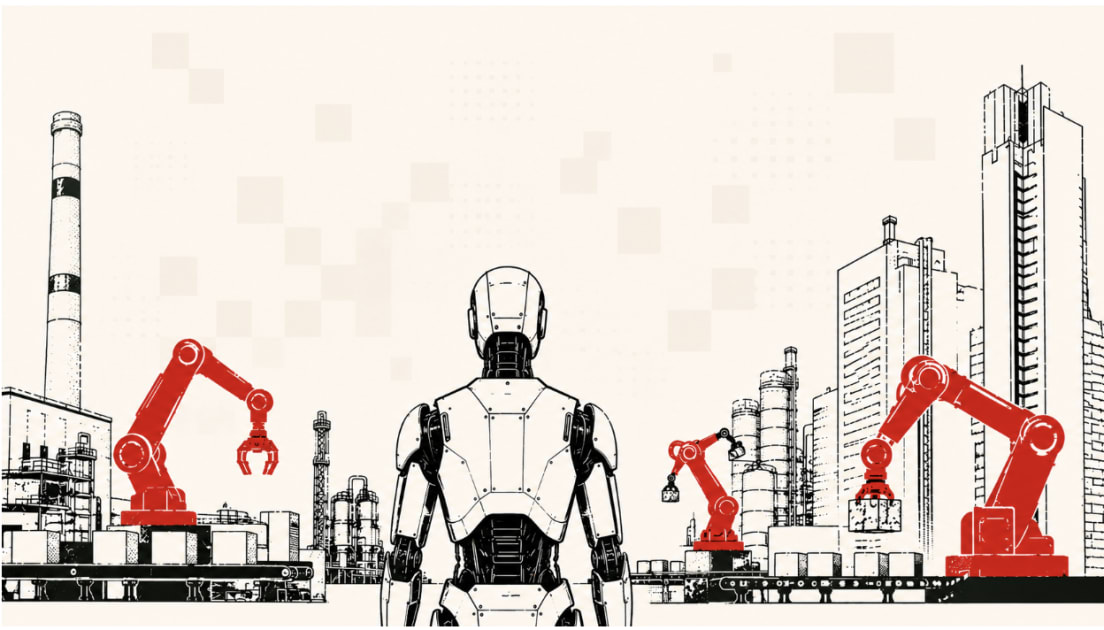
Manufacturing is entering a new era of intelligent operations.
For decades, manufacturers have invested in automation, robotics, industrial sensors, and connected machinery to improve productivity. These technologies have transformed production environments, but many manufacturing systems still operate in silos. Machines generate data, monitoring platforms identify issues, and employees decide what to do next.
Agentic AI is beginning to change that model.
Instead of simply detecting an anomaly or predicting a potential failure, AI agents can interpret operational context, evaluate possible actions, coordinate workflows, and initiate responses within defined controls. This creates a shift from monitoring and prediction to intelligent decision-making and action. Recent manufacturing research and industry roadmaps increasingly identify autonomous systems, predictive maintenance, digital twins, robotics, and AI-driven operations as key components of the next generation of smart manufacturing.
From Automated Factories to Intelligent Factories
Traditional automation is highly effective when processes are predictable.
A machine follows programmed instructions. A production line executes a predefined sequence. A monitoring system raises an alert when a value crosses a threshold.
The challenge begins when conditions change.
A supplier shipment is delayed. Demand suddenly increases. A machine starts showing unusual vibration patterns. Production capacity changes. Energy consumption rises unexpectedly.
In these situations, conventional systems may identify the problem but still depend on people to interpret the situation and coordinate the response.
Agentic AI introduces another layer of intelligence.
An agent can bring together machine data, production schedules, maintenance records, inventory information, and operational constraints to determine what should happen next. In manufacturing environments, this creates the possibility of continuously adapting operations rather than simply reacting to individual alerts.
Predictive Maintenance Becomes Proactive Action
Predictive maintenance is one of the clearest applications of Agentic AI in manufacturing.
Traditional maintenance models analyze equipment data to estimate the likelihood of failure. This helps maintenance teams identify assets that require attention.
Agentic AI can take the process further.
An intelligent maintenance agent can monitor equipment conditions, analyze historical maintenance records, evaluate production schedules, and determine the most appropriate maintenance window.
For example, if a motor begins showing abnormal vibration patterns, the agent could:
Identify the potential failure
Assess the severity and operational impact
Check maintenance history
Review spare-parts availability
Identify an appropriate maintenance window
Create or recommend a work order
Notify the relevant maintenance team
This creates a closed-loop maintenance process where intelligence moves from prediction to coordinated action. Industry research is increasingly exploring this transition toward agentic maintenance workflows and autonomous maintenance decision-making.
Smarter Production Planning
Manufacturing schedules are influenced by multiple variables.
Demand, machine availability, workforce capacity, raw material availability, maintenance requirements, and delivery commitments all need to be considered simultaneously.
AI agents can continuously evaluate these variables and identify potential conflicts before they disrupt production.
If a critical machine becomes unavailable, an agent can assess alternative production lines, review available capacity, evaluate delivery commitments, and recommend adjustments.
This moves production planning away from static schedules toward adaptive decision-making.
Research into agentic manufacturing operations is exploring architectures where activities such as scheduling, dispatching, execution management, resource management, and performance analysis can be supported by specialized autonomous agents working alongside established manufacturing systems.
Quality Control With Continuous Intelligence
Quality control is another area where Agentic AI can extend existing capabilities.
Computer vision and machine learning systems can already identify defects, irregularities, and deviations during production.
Agentic systems can connect these insights with operational context.
When a defect is detected, an AI agent could investigate related machine parameters, compare current production conditions with historical patterns, identify possible root causes, and recommend corrective actions.
This creates a continuous quality loop:
Detect → Analyze → Identify → Recommend → Act → Monitor
Human experts can remain involved in critical decisions while AI handles the analysis and coordination required to respond quickly.
This human-in-the-loop model is particularly important in industrial environments where safety, quality, and reliability cannot be compromised.
Supply Chains Become More Adaptive
Manufacturing performance depends on what happens beyond the factory floor.
Supplier delays, logistics disruptions, changing demand, and raw material shortages can quickly affect production schedules.
Agentic AI can connect manufacturing operations with supply chain intelligence.
An agent could monitor supplier updates, inventory levels, demand forecasts, logistics conditions, and production requirements. When a disruption occurs, it can evaluate alternatives and recommend adjustments to sourcing, production, or distribution.
This enables manufacturing organizations to move toward more adaptive supply chains where decisions are continuously informed by real-time conditions rather than periodic planning cycles.
Digital Twins Add Another Layer of Intelligence
Digital twins provide manufacturers with virtual representations of physical assets, production lines, or facilities.
When combined with Agentic AI, they can become powerful environments for evaluating operational decisions.
An agent can simulate potential changes before recommending them.
For example, before changing a production schedule, the system could evaluate the potential impact on machine utilization, throughput, maintenance requirements, inventory, and delivery commitments.
This enables manufacturers to test decisions digitally before applying them to physical operations.
The combination of AI agents, digital twins, real-time data, and industrial systems is emerging as an important direction for intelligent manufacturing.
The Data Foundation Matters
Agentic AI cannot operate effectively without reliable industrial data.
Manufacturing environments often contain a combination of legacy equipment, PLCs, MES platforms, ERP systems, sensors, cloud applications, and disconnected databases.
Bringing these sources together is essential.
Modern manufacturing AI architectures increasingly emphasize unified data, edge computing, industrial connectivity, and integration between operational technology and enterprise systems. NIST's 2026 smart manufacturing roadmap specifically highlights data management, heterogeneous sensing and control systems, trustworthy AI, and reliable operation as important challenges for industrial AI adoption. The objective is not simply to collect more data.
It is to make the right data available to intelligent systems at the right time and in the right context.
Autonomy Requires Governance
Autonomous operations do not mean removing humans from manufacturing.
In high-stakes industrial environments, human oversight remains essential.
Manufacturers need clearly defined decision boundaries, permissions, escalation mechanisms, audit trails, and safety controls before allowing AI systems to take operational actions.
The most practical model is therefore not AI replacing operators, but AI extending operational intelligence.
People establish objectives, policies, and constraints. AI agents continuously monitor conditions, analyze information, coordinate routine actions, and escalate decisions that require human judgment.
This balance allows manufacturers to increase autonomy without sacrificing accountability. Building the Intelligent Factory
The transition to Agentic AI does not happen by replacing every existing manufacturing system.
It begins by identifying high-value operational challenges where intelligent decision-making can create measurable impact.
Manufacturers can start with areas such as:
Predictive maintenance
Production scheduling
Quality monitoring
Inventory optimization
Supply chain coordination
Energy optimization
Asset performance management
Once the data foundation, integration layer, governance model, and AI capabilities are established, these use cases can gradually connect into broader intelligent operations.
The long-term opportunity is an interconnected manufacturing environment where machines, data platforms, AI agents, and human teams work together continuously.
The Future of Manufacturing Is Autonomous, Not Unattended
Agentic AI is changing the definition of smart manufacturing.
The next generation of factories will not simply collect data or automate repetitive tasks. They will increasingly be able to sense operational conditions, understand context, predict what may happen, evaluate options, and coordinate appropriate actions.
For manufacturers, this can mean fewer unexpected disruptions, more adaptive production, better asset utilization, faster decision-making, and greater operational resilience.
At SNS Square, we help organizations explore and build AI-driven manufacturing solutions that connect data, intelligence, automation, and enterprise workflows. From predictive maintenance and intelligent quality management to production optimization and Agentic AI, the focus remains on transforming complex manufacturing challenges into measurable business outcomes.
The future factory will not simply be automated.
It will be intelligent, adaptive, and increasingly capable of acting on what it learns.
Comments0
Please login to join the conversation
Be the first to comment!