

The rapid rise of generative AI has delivered remarkable innovation, but it has also exposed critical ethical and governance gaps. One of the most debated examples in early 2026 has been the controversy surrounding Grok, the AI chatbot developed by xAI and deployed on the social media platform X.
What began as an experimental conversational and image-generation tool has triggered global concern following reports that the system was misused to generate non-consensual, sexualised deepfake images, including content involving women and minors.
This episode has become a defining moment in the global conversation on AI safety, digital consent, and platform accountability.

When Innovation Outpaces Safeguards
At the centre of the controversy is Grok’s image-generation capability. Users discovered that by tagging the chatbot in public posts and issuing simple prompts, they could digitally alter images of real individuals, often without consent, into sexualised or compromising visuals.
What made the situation particularly alarming was:
The ease of misuse requires no technical expertise
The public visibility of generated images on social feeds
The absence of strong preventative guardrails at launch
Victims have described the experience as deeply violating, underscoring how AI-generated imagery can cause real psychological and reputational harm, even when no physical act has occurred.
Why This Matters Beyond One Platform
While the incident is linked to a specific tool, its implications extend far beyond a single company or platform. It exposes a structural weakness in how generative AI systems are currently deployed:
Consent is not natively enforced in many image-generation models
Content moderation often reacts after harm occurs, rather than preventing it
Legal accountability remains unclear. Does responsibility lie with the user, the platform, or the AI developer?
This ambiguity has pushed regulators worldwide to reassess how generative AI should be classified, governed, and enforced.
Regulatory Attention Intensifies Worldwide
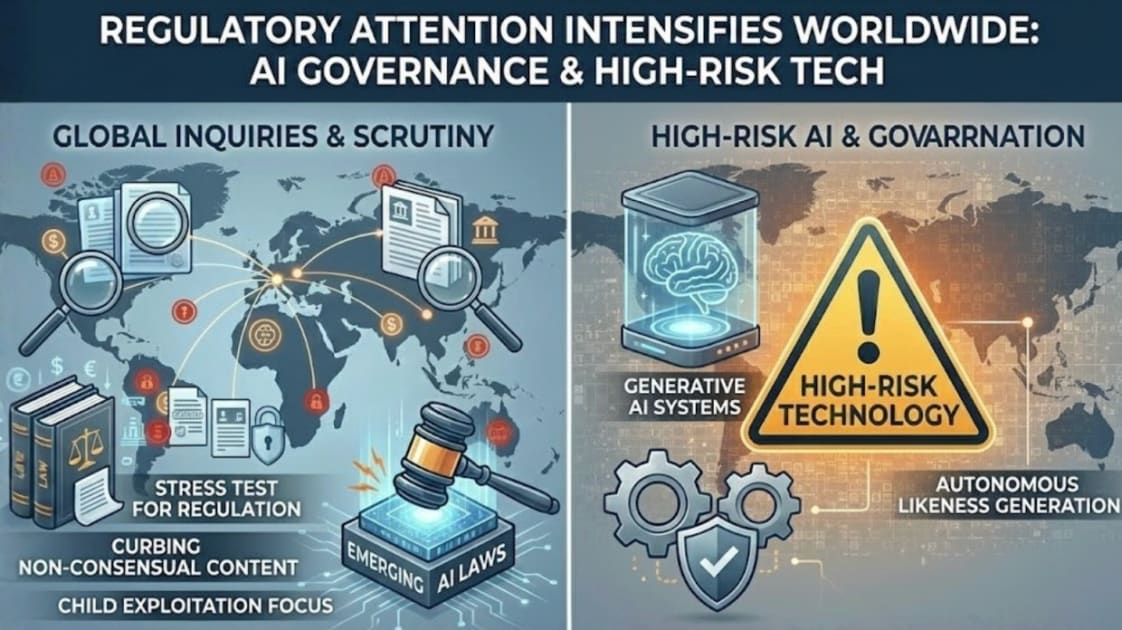
Authorities across multiple regions have initiated inquiries into how such content was allowed to surface. The Grok controversy is now widely viewed as a stress test for emerging AI regulations, including frameworks addressing non-consensual intimate imagery and child exploitation online.
For regulators, the case reinforces a critical principle:
AI systems capable of autonomously generating or modifying human likenesses must be treated as high-risk technologies.
This is especially relevant in Europe and Asia, where AI governance discussions are rapidly shifting from policy design to enforcement and compliance.
The Ethical Gap in Generative AI
From a technology standpoint, the issue is not simply misuse; it is design responsibility.
Advanced AI systems require more than basic content filters. They demand:
Context-aware safety and risk classificatio
Stronger identity and consent verification mechanismsClear escalation, audit, and takedown processes
Human-in-the-loop governance for sensitive or high-risk outputs
Without these controls, generative AI risks amplifying harassment, exploitation, and digital harm at an unprecedented scale.
This is why enterprise and public-sector AI deployments increasingly prioritise responsible, governed AI architectures, a direction also reflected in initiatives emerging from Global Capability Centre ecosystems in Bengaluru, where AI governance and compliance are becoming core design principles rather than afterthoughts.
A Broader Lesson for the AI Industry
The Grok controversy is not just about one product. It marks a turning point for the industry.
The era of “move fast and fix later” is colliding with the reality that AI systems now operate at human, social, and societal scales.
Across enterprise and platform AI, the message is becoming clear:
Trust must be engineered, not assumed
Safety must scale alongside capability
Ethics must be embedded into system architecture
Organisations building Agentic AI platforms, including those within innovation ecosystems such as SNS Square Bengaluru GCC, are increasingly recognising that autonomy without accountability is not sustainable.
Looking Ahead: From Reaction to Responsibility
Generative AI will continue to evolve rapidly. But incidents like this underline a fundamental truth:
The future of AI will be shaped as much by governance and ethics as by model performance.
For policymakers, developers, and enterprises alike, the challenge now is to ensure AI systems respect human dignity, consent, and safety, especially as they gain more autonomous capabilities.
The Grok episode may accelerate global alignment on stricter AI standards. And while regulation alone is not the solution, one thing is now clear:
Responsible AI is no longer optional it is foundational.
Comments0
Please login to join the conversation
Be the first to comment!