
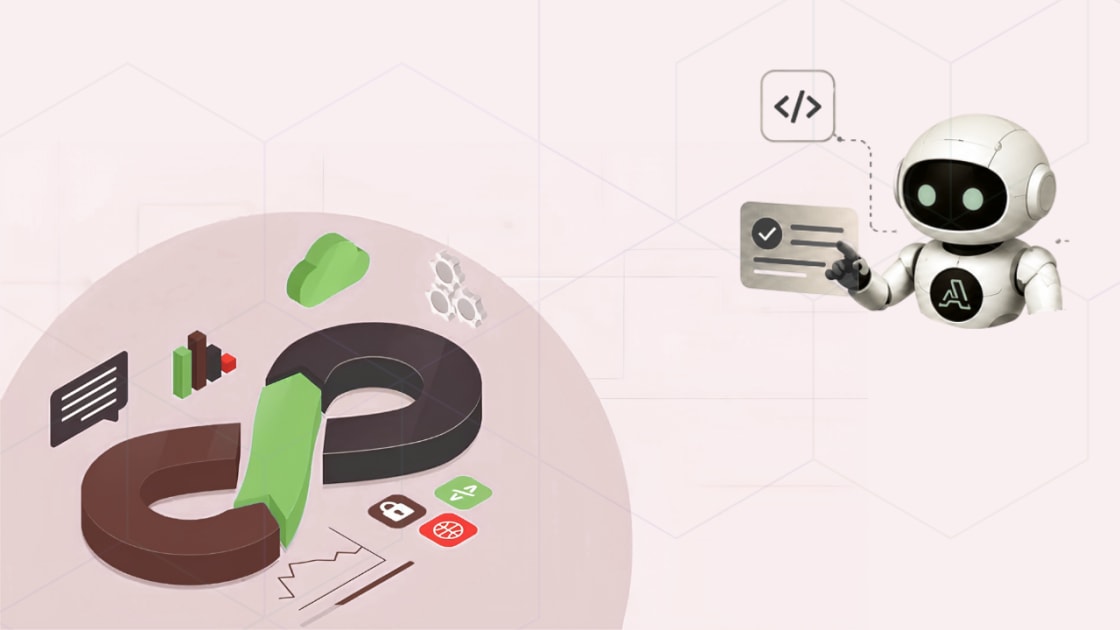
Modern enterprises are built on complex, distributed systems. From cloud-native applications to microservices architectures, the DevOps lifecycle has become faster, more scalable, and increasingly difficult to manage. Yet despite advancements in tooling, one persistent challenge remains unchanged.
Infrastructure failures are still silent, cascading, and reactive.
These failures often go unnoticed until they escalate into system-wide disruptions, resulting in high mean time to resolution, unplanned downtime, and significant revenue leakage. The traditional approach to DevOps monitoring and incident management is no longer sufficient for the speed and scale at which enterprises operate today.
This is where the shift toward Agentic AI-driven DevOps begins.
The Problem: Reactive DevOps in a Real-Time World
DevOps was designed to accelerate delivery and improve collaboration between development and operations. However, most systems today still rely heavily on reactive workflows.
Alerts are triggered after failures occur
Teams manually investigate root causes
Resolution depends on human intervention
Knowledge remains siloed across tools and teams
As systems grow more interconnected, a single failure can propagate across services, making it harder to detect, diagnose, and resolve issues in real time.
The result is a cycle of firefighting rather than prevention.

The Shift: From Monitoring to Intelligent Action
The next evolution of DevOps is not just better monitoring. It is autonomous decision-making.
AI-powered DevOps systems are moving beyond dashboards and alerts into self-aware, self-healing ecosystems. These systems do not just detect anomalies. They understand context, predict failures, and take corrective actions automatically.
At the center of this transformation are DevOps Auto-Healing Agents.
What Are DevOps Auto-Healing Agents
Auto-healing agents are intelligent systems that continuously monitor infrastructure, detect anomalies, identify root causes, and execute remediation actions without human intervention.
They operate across the entire DevOps lifecycle
Plan with predictive insights based on historical patterns
Build with intelligent validation and risk detection
Deploy with automated rollback and failure prevention
Operate with continuous monitoring and anomaly detection
Test with adaptive feedback loops
Release with confidence backed by real-time intelligence
Instead of waiting for incidents to occur, these agents proactively maintain system health.
How Agentic AI Transforms DevOps Operations
1. Real-Time Anomaly Detection
AI agents analyze logs, metrics, and traces in real time to identify deviations before they become incidents
2. Root Cause Intelligence
Instead of manual debugging, agents correlate signals across systems to pinpoint the exact source of failure
3. Autonomous Remediation
From restarting services to scaling infrastructure or rolling back deployments, agents execute corrective actions instantly
4. Continuous Learning
Every incident improves the system. AI agents learn from past patterns to prevent future failures
5. Closed-Loop Operations
Detection, diagnosis, and resolution are connected into a seamless, automated loop
Business Impact: Beyond Uptime
The value of auto-healing DevOps systems extends far beyond operational efficiency.
Reduced MTTR through instant resolution
Minimized downtime and service disruption
Lower operational costs with reduced manual intervention
Improved reliability and customer experience
Faster release cycles with higher confidence
For enterprises operating at scale, this shift directly impacts revenue, trust, and competitive advantage.
The SNS Square Approach to Intelligent DevOps
At SNS Square, we design and implement Agentic AI-driven DevOps systems that move organizations from reactive operations to autonomous execution.
Our approach focuses on integrating intelligence into every layer of the DevOps lifecycle.
What We Enable
AI-powered monitoring with real-time insights
Autonomous incident detection and resolution
Self-healing infrastructure systems
Seamless integration across DevOps tools and platforms
Scalable architectures aligned with enterprise needs
We do not just automate workflows. We build systems that think, learn, and act.
From Downtime to Self-Healing Systems
The future of DevOps is not about managing failures. It is about eliminating them before they happen.
As enterprises continue to scale their digital operations, the ability to respond in real time will no longer be optional. It will be foundational.
Agentic AI introduces a new operating model where systems are not just monitored but actively maintained by intelligent agents.
Conclusion
DevOps is entering a new phase where speed, scale, and complexity demand more than human-driven operations.
Auto-healing agents redefine how infrastructure is managed. They reduce risk, improve reliability, and enable organizations to operate with confidence in an always-on world.
At SNS Square, we help enterprises build this future by embedding intelligence directly into their DevOps ecosystems.
Comments0
Please login to join the conversation
Be the first to comment!