

In late 2022, the launch of ChatGPT triggered what many inside Google reportedly described as a “Code Red.” For the first time in years, the company that pioneered much of modern AI research appeared to be caught off guard. Early chatbot launches faced criticism, public confidence wavered, and industry observers questioned whether Google had lost its edge in artificial intelligence.
Fast forward to 2025, and the narrative has changed dramatically.
Google has executed one of the most significant AI comebacks in recent technology history quietly, steadily, and with deep structural advantages that now place it firmly among the leaders of the global AI race.

A Long Game Built on AI-First Thinking
While public attention often focuses on product launches, Google’s AI strategy has been years in the making. The company declared itself “AI-first” as early as 2016, investing heavily in foundational research, large-scale infrastructure, and top-tier talent long before generative AI entered the mainstream conversation.
This long-term approach meant that even when early consumer-facing AI products struggled, the core systems, data pipelines, model research, and compute infrastructure continued to mature behind the scenes.
By 2025, that patience will have paid off.
Gemini 3 and the Shift to Production-Ready AI
Google’s latest model, Gemini 3, has been widely recognised for its performance across reasoning, multimodal capabilities, and enterprise-grade use cases. More importantly, Gemini signals a shift from experimental AI to production-ready systems designed to operate at scale.
Rather than positioning AI as a standalone chatbot, Google is embedding intelligence directly into search, productivity tools, cloud platforms, and developer ecosystems. This reflects a broader enterprise reality: AI is no longer an assistant, it is becoming part of the operating layer.
This same transition is increasingly visible across enterprise technology ecosystems, including Global Capability Centre (GCC) environments in Bengaluru, where AI systems are being designed to execute decisions, not merely generate responses
Infrastructure Advantage: TPUs and Cloud Scale
One of Google’s most underappreciated strengths lies in its infrastructure. The company’s custom-built Tensor Processing Units (TPUs) provide a high cost, performance, and scalability advantage over competitors reliant on third-party hardware.
In 2025, Google expanded access to TPUs for external enterprises, enabling organisations to train and deploy large-scale AI models more efficiently. This move has strengthened Google Cloud’s position and reinforced a critical enterprise lesson: sustainable AI leadership depends on owning the full stack—data, models, and compute.
This infrastructure-first mindset closely mirrors how Agentic AI platforms are being architected in advanced enterprise settings, including transformation initiatives emerging from SNS Square Bengaluru GCC–led programs.

Regulation, Trust, and Enterprise Readiness
Another factor supporting Google’s resurgence is regulatory momentum. Recent antitrust developments have reduced uncertainty around its cloud and AI expansion, allowing the company to accelerate enterprise partnerships with greater confidence.
At the same time, Google’s focus on responsible AI, security, and governance is resonating strongly with regulated industries. Enterprises are increasingly cautious about deploying AI systems that lack transparency, observability, or control. Google’s approach positions it well for adoption across sectors such as finance, healthcare, and public services.
This governance-first perspective is also shaping how organisations collaborate with GCC build specialists in Bengaluru, where trust, compliance, and operational resilience are foundational to AI deployment.
Execution Over Speed: A Strategic Reversal
One of the most important lessons from Google’s comeback is strategic restraint. Rather than racing to be first, the company focused on being right, refining models, strengthening infrastructure, and aligning AI deeply with real business use cases.
As CEO, Sundar Pichai has repeatedly emphasised that leadership in AI is not defined by speed alone, but by execution quality at scale.
This philosophy is increasingly echoed across enterprises transitioning from experimentation to execution particularly those moving from analytics and automation toward Data-to-Agentic AI transformation models emerging across Bengaluru’s enterprise ecosystem.
What Google’s Comeback Signals for the AI Landscape
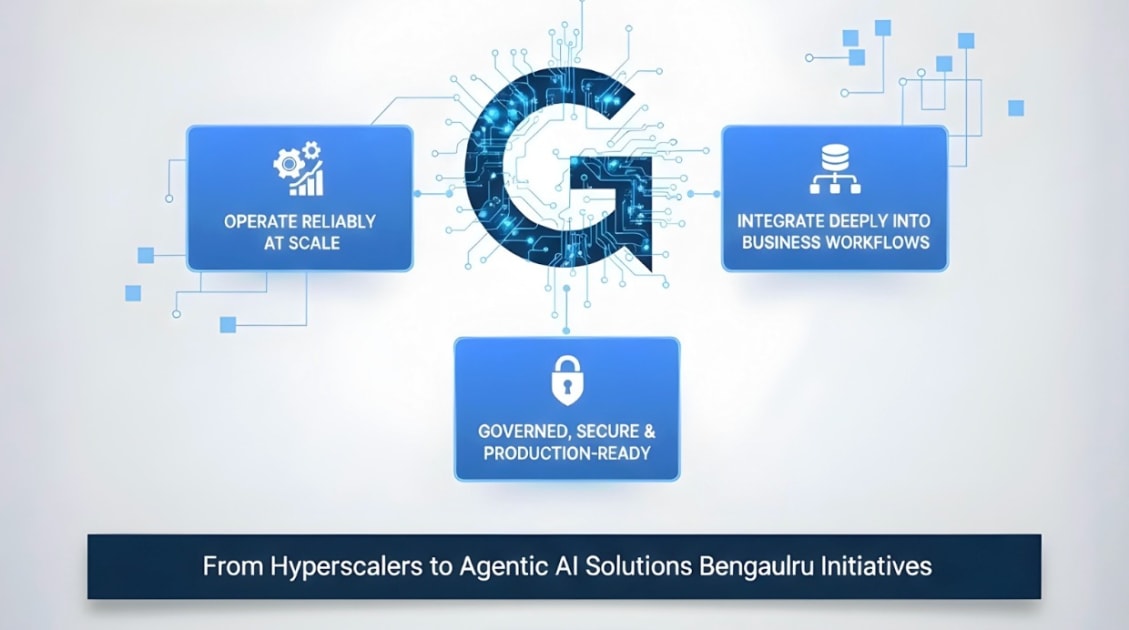
Google’s return to the forefront of AI is not just a company story; it signals a broader industry shift. The next phase of AI leadership will be defined less by demos and more by systems that:
Operate reliably at scale
Integrate deeply into business workflows
Are governed, secure, and production-ready
This is the same direction shaping enterprise AI adoption globally, from hyperscalers to Agentic AI solutions
Looking Ahead
Google’s journey from “Code Red” to AI front-runner highlights a critical truth: sustainable AI leadership is built over years, not headlines. With Gemini, TPUs, and an execution-first strategy, Google is well-positioned for the next phase of enterprise and platform AI.
As AI continues to evolve from tools to systems, organisations that combine infrastructure depth, governance, and contextual intelligence will define the future, whether they are global technology leaders or enterprise innovation hubs like those evolving within SNS Square Bengaluru GCC, a GCC Build Specialist focused on building scalable, enterprise-ready Agentic AI platforms.
Comments0
Please login to join the conversation
Be the first to comment!