
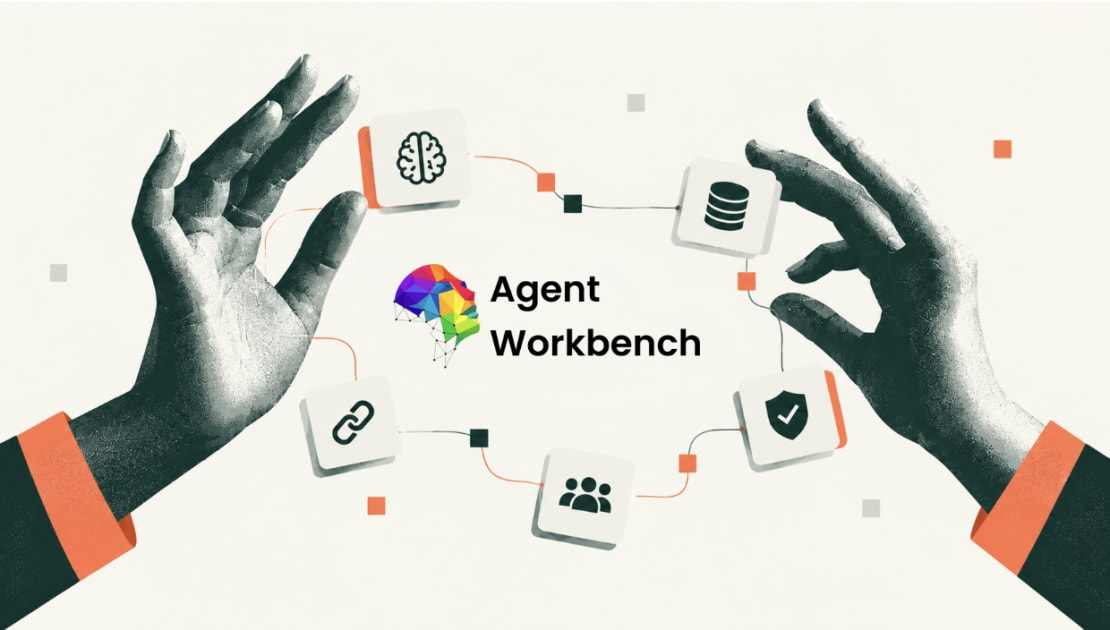
From General-Purpose AI to Business-Specific Intelligence
Artificial Intelligence is moving beyond experimentation. Enterprises are increasingly looking for AI systems that can work within their specific processes, understand industry context, interact with existing technology, and deliver measurable business outcomes.
A generic AI model can generate an answer. But enterprise operations often require much more.
A banking organization needs AI that understands compliance workflows. A manufacturer needs intelligence around equipment, production, and supply chains. A healthcare provider needs systems that operate within sensitive data and operational environments. A government agency needs secure, accessible, and compliant citizen services.
This is where industry-specific AI agents become valuable.
The SNS Square Agentic Workbench provides a foundation for organizations to build and orchestrate AI agents designed around specific business functions, industry requirements, and enterprise workflows.
Why Industry-Specific AI Agents Matter
Every industry has its own terminology, processes, regulations, data sources, and operational priorities.
A customer support agent for a retail organization cannot simply be transferred into a banking environment and expected to deliver the same results. The underlying objectives, systems, compliance requirements, and decision-making processes are different.
Industry-specific AI agents are designed with this context in mind.
They can be configured to understand:
Business processes
Industry terminology
Enterprise data
Organizational policies
Existing applications
Workflow requirements
Security and governance controls
This allows AI to become more relevant to the way an organization actually operates.
The goal is not simply to create an AI assistant that can answer questions. It is to build an intelligent system capable of supporting or executing meaningful business workflows.
Inside the SNS Square Agentic Workbench
The SNS Square Agentic Workbench provides an environment for building, integrating, and scaling enterprise AI agents.
Rather than developing every agent independently, organizations can use a structured foundation to create intelligent solutions across business functions.
The workbench brings together the key components required for enterprise Agentic AI, including:
Agent Building
Organizations can develop specialized agents for specific business processes and operational requirements.
These agents can be designed around individual functions such as customer support, finance, supply chain, HR, IT operations, or compliance.
Integration
Enterprise AI becomes more valuable when it can work with existing systems.
AI agents can be connected to relevant enterprise applications, data sources, and workflows, allowing them to retrieve information and support actions within the broader technology environment.
Data and AI
Industry-specific agents depend on relevant and reliable information.
The workbench enables organizations to connect AI capabilities with enterprise data and intelligence layers, creating solutions that operate with greater business context.
Orchestration
Complex business processes often require more than one AI capability.
Agent orchestration enables specialized agents to work together across a broader workflow, coordinating activities and passing information between tasks.
Security and Governance
Enterprise AI requires appropriate controls.
AI agents need defined permissions, governance policies, monitoring, and human oversight, particularly when they operate within sensitive or regulated environments.
From One Agent to an Intelligent Workforce
The real opportunity emerges when organizations move beyond individual AI agents.
Consider a manufacturing operation.
A Predictive Maintenance Agent can monitor equipment data and identify potential failures.
A Production Planning Agent can evaluate capacity and schedules.
A Supply Chain Agent can monitor inventory and supplier conditions.
An Operations Agent can coordinate information across these systems and escalate critical decisions.
Individually, each agent addresses a specific function.
Together, they can create an intelligent operational ecosystem.
The same model can be applied across financial services, healthcare, retail, telecommunications, manufacturing, and public services.
Industry Applications
Financial Services
AI agents can support KYC, AML, document processing, fraud monitoring, customer operations, and financial workflows.
Healthcare
Agents can support patient flow, remote monitoring, medical imaging workflows, administrative operations, and healthcare documentation.
Manufacturing
AI agents can assist with predictive maintenance, quality management, production planning, inventory optimization, and operational monitoring.
Retail
Retail organizations can deploy agents for demand forecasting, dynamic pricing, customer engagement, inventory management, and personalized experiences.
Public Services
Government organizations can use AI agents for citizen support, document processing, service requests, multilingual engagement, and administrative workflows.
The value comes from adapting AI to the specific environment rather than treating every organization as the same.
Designing Agents Around Business Outcomes
Building an AI agent should begin with a business problem.
Before introducing an agent, organizations should understand:
What process needs improvement?
Is the challenge excessive manual work, slow response times, fragmented information, operational errors, or limited visibility?
What should the agent accomplish?
The objective should be measurable and connected to a business outcome.
What information does it need?
The agent should have access to the right enterprise data and knowledge sources.
What actions can it take?
Clear boundaries should define which activities can be automated and which require human approval.
How will success be measured?
Organizations should track meaningful metrics such as processing time, productivity, accuracy, service quality, cost efficiency, or resolution rates.
This outcome-driven approach helps ensure that Agentic AI becomes a business capability rather than another technology experiment.
Human Expertise Still Matters
Industry-specific AI does not mean removing humans from the process.
In many enterprise environments, human expertise remains essential for complex decisions, exceptions, approvals, and accountability.
The more effective model is collaboration.
AI agents handle high-volume analysis, repetitive workflows, information retrieval, and routine decisions within defined boundaries.
People focus on judgment, strategy, relationships, and exceptions.
This creates a human-AI operating model where technology increases the capacity of teams rather than simply replacing them.
From Experimentation to Enterprise Scale
One of the biggest challenges organizations face with AI is moving from isolated pilots to scalable deployment.
A structured Agentic AI platform can help organizations establish a repeatable approach.
Instead of developing every solution from scratch, enterprises can create reusable capabilities, integrate agents with existing systems, apply governance consistently, and expand successful use cases across departments.
This makes AI adoption more systematic.
A successful customer service agent can become the foundation for other service workflows. A document processing capability can support finance, procurement, compliance, and HR. An orchestration layer can connect multiple specialized agents into broader operational workflows.
The result is an AI ecosystem that grows with the organization.
Building the Next Generation of Enterprise AI
Industry-specific AI agents represent an important shift in enterprise technology.
The question is no longer whether AI can generate intelligent responses. The bigger question is whether AI can understand the business context, work within enterprise systems, and contribute directly to operational outcomes.
The SNS Square Agentic Workbench provides a foundation for organizations looking to build that capability.
By combining specialized AI agents, enterprise data, integrations, orchestration, and governance, organizations can move toward intelligent workflows designed around the realities of their industries.
The future of enterprise AI will not be built around one universal agent.
It will be built around networks of specialized agents that understand the business, work together, and deliver outcomes.
And that is where industry-specific Agentic AI begins to move from an idea into an enterprise capability.
Today 12:59 PM
The Five Layers of an Enterprise Agentic AI Platform: Inside SNS Square’s Agentic Workbench
The Five Layers of an Enterprise Agentic AI Platform: Inside SNS Square’s Agentic Workbench
Introduction
Enterprise AI is moving beyond isolated chatbots and single-purpose automation.
Organizations are now looking to build AI systems that can understand business context, reason across information, use enterprise tools, execute workflows, and continuously support business operations. But building such systems at scale requires more than a powerful foundation model.
It requires an architecture.
An enterprise Agentic AI platform must bring together intelligence, enterprise knowledge, tools, orchestration, and governance in a structured environment. Without these layers, organizations can end up with disconnected AI experiments that are difficult to integrate, govern, or scale.
The SNS Square Agentic Workbench is designed around this broader approach—providing a foundation for building enterprise AI agents that can move from understanding a task to taking meaningful action.
A useful way to understand this architecture is through five interconnected layers.
1. Intelligence Layer: The Reasoning Engine
At the foundation of an Agentic AI platform is intelligence.
This is where AI models interpret requests, understand context, reason through problems, and determine what needs to happen next.
Traditional automation generally follows predefined instructions:
Input → Rule → Action
Agentic systems introduce a more dynamic process:
Goal → Understand → Reason → Plan → Act → Evaluate
The intelligence layer enables agents to determine how a task should be approached rather than simply executing a fixed sequence.
For enterprises, this capability is particularly valuable when processes involve ambiguity, multiple systems, changing information, or exceptions.
An AI agent supporting a finance workflow, for example, may need to understand a document, identify missing information, evaluate the business context, and determine the next appropriate step.
The intelligence layer provides the reasoning capability behind that process.
2. Knowledge Layer: Giving AI Business Context
Intelligence alone is not enough.
An AI model may be highly capable, but enterprise decisions depend on organizational knowledge, internal policies, industry information, and proprietary data.
The knowledge layer connects agents with the information they need to operate within a specific business environment.
This can include:
Enterprise documents
Knowledge bases
Policies and procedures
Product information
Customer data
Operational records
Industry-specific knowledge
This layer helps transform a general-purpose AI capability into a business-aware system.
For example, a customer service agent should not simply provide a generic response. It should understand the organization's products, policies, customer context, and service processes.
The more effectively enterprise knowledge is connected to AI, the more relevant and useful the agent becomes.
3. Tool & Integration Layer: Moving From Answers to Actions
The defining characteristic of an enterprise AI agent is its ability to do more than generate information.
It needs to interact with the systems where work actually happens.
The tool and integration layer enables agents to connect with enterprise applications, APIs, databases, business platforms, and operational systems.
This is what allows an agent to move from:
“Here is what you should do.”
to:
“I have completed the next step.”
Consider an IT operations scenario.
An AI agent identifies a potential infrastructure issue. Instead of simply alerting an engineer, it can access monitoring information, investigate the issue, check relevant operational data, initiate an approved workflow, and escalate the incident when required.
The agent becomes part of the workflow rather than remaining outside it.
For enterprises, this layer is critical because AI value is ultimately determined by its ability to integrate with existing technology and business processes.
4. Agent Orchestration Layer: Coordinating Intelligent Work
Complex enterprise processes rarely belong to a single function.
They often involve multiple teams, systems, and decisions.
This is where orchestration becomes important.
The orchestration layer coordinates agents, tasks, tools, and workflows so that different capabilities can work together toward a larger objective.
Instead of one agent attempting to handle everything, enterprises can create specialized agents for specific responsibilities.
For example, a financial workflow could involve:
Document Agent → extracts information
Compliance Agent → validates requirements
Risk Agent → identifies potential concerns
Workflow Agent → coordinates the process
Each agent has a defined responsibility, while orchestration connects them into one intelligent workflow.
This approach allows enterprises to build systems that are modular, scalable, and better aligned with complex operational environments.
The result is not simply a collection of AI agents, but an agent ecosystem designed to work together.
5. Governance & Control Layer: Enterprise-Ready Autonomy
The more capable AI becomes, the more important governance becomes.
Enterprise agents may interact with sensitive information, make recommendations, and in some cases initiate actions. Organizations therefore need mechanisms to control what agents can access and what they are permitted to do.
The governance layer provides the foundation for responsible enterprise deployment.
Key considerations include:
Access controls
Permissions
Data security
Human oversight
Auditability
Monitoring
Policy enforcement
Exception handling
Not every action should be autonomous.
A well-designed enterprise AI environment can establish different levels of autonomy depending on the risk involved.
A low-risk task might be completed automatically, while a high-impact financial, operational, or compliance decision may require human approval.
This creates controlled autonomy—allowing AI to move quickly while keeping critical decisions accountable.
How the Five Layers Work Together
The real strength of an Agentic AI platform comes from the interaction between these layers.
Imagine a manufacturing organization facing an unexpected equipment issue.
The Intelligence Layer understands the problem.
The Knowledge Layer provides equipment history, maintenance policies, and operational context.
The Integration Layer connects the agent to monitoring, maintenance, inventory, and enterprise systems.
The Orchestration Layer coordinates the required agents and workflows.
The Governance Layer ensures that actions remain within approved boundaries and escalates decisions that require human intervention.
Together, these layers create a complete intelligent workflow.
This is the difference between an AI tool and an enterprise Agentic AI platform.
Why a Layered Architecture Matters
Organizations often begin their AI journey with individual use cases.
A chatbot here. A document-processing solution there. An automation workflow somewhere else.
While these initiatives can deliver value, scaling them independently can create fragmented AI environments.
A layered architecture provides a more systematic approach.
It allows enterprises to build reusable capabilities, connect different AI agents, standardize governance, and expand successful use cases across departments and industries.
This becomes particularly important as organizations move from individual AI pilots toward enterprise-wide Agentic AI strategies.
Inside SNS Square’s Agentic AI Vision
The SNS Square Agentic Workbench represents this shift from individual AI applications toward a structured enterprise AI environment.
The objective is to help organizations build AI agents that are not only intelligent, but also context-aware, connected, orchestrated, and governed.
Whether the requirement involves customer operations, finance, healthcare, manufacturing, IT, or other enterprise functions, the underlying principle remains the same:
AI should understand the business, work with the systems, and contribute to the outcome.
As enterprises move toward increasingly autonomous operations, the architecture supporting those systems will become just as important as the AI models themselves.
Conclusion
Enterprise Agentic AI is not a single technology.
It is an ecosystem of capabilities working together.
The five layers—Intelligence, Knowledge, Tools & Integrations, Orchestration, and Governance—provide a practical way to understand what is required to move from AI experimentation to enterprise-scale intelligent operations.
The next generation of enterprise AI will not simply answer questions.
It will understand context, coordinate capabilities, interact with systems, execute workflows, and operate within clearly defined boundaries.
That is the direction Agentic AI is taking—and platforms such as the SNS Square Agentic Workbench provide the foundation for organizations ready to build for that future.
Comments0
Please login to join the conversation
Be the first to comment!