

In today’s always-on digital economy, IT infrastructure is no longer a background function. It is the foundation that enables business continuity, customer experience, security, and innovation. As enterprises scale across cloud, on-premise, and hybrid environments, managing infrastructure through traditional, manual approaches has become increasingly complex and inefficient.
This is where AI and automation are fundamentally changing the game.
By moving beyond rule-based automation toward intelligent, adaptive systems, organizations are transforming IT infrastructure from a reactive cost center into a proactive, resilient, and self-optimizing capability. For enterprises building modern Global Capability Centres and AI-native operations, this shift is becoming essential.
The Growing Complexity of Modern IT Infrastructure
Enterprise IT environments today span multiple clouds, legacy systems, SaaS platforms, data centers, and edge devices. With this complexity comes a set of persistent challenges:
Increasing downtime risks due to system interdependencies
Manual monitoring that struggles to scale
Slower incident response and root-cause analysis
Rising operational costs and tool sprawl
Security vulnerabilities across distributed environments
Traditional monitoring and automation tools operate on static rules. They react after failures occur and often require human intervention to diagnose and resolve issues. As infrastructure becomes more dynamic, this approach is no longer sustainable.
AI-driven infrastructure management introduces a fundamentally different model.
From Reactive Operations to Intelligent Infrastructure
AI-enabled infrastructure management systems continuously analyze logs, metrics, events, and performance data across environments. Instead of waiting for alerts, these systems identify patterns, predict anomalies, and recommend or execute corrective actions in real time.
This shift aligns closely with the rise of Agentic AI, where systems act as contextual decision-makers rather than passive tools. Within enterprise environments, this means infrastructure that can sense, decide, and act with minimal human intervention.
Organizations building AI-native GCCs increasingly adopt this model to support scale, reliability, and speed without proportionally increasing headcount.
Key Benefits of AI and Automation in IT Infrastructure Management
1. Proactive Incident Prevention
AI models can detect early warning signals long before outages occur. By analyzing historical trends and real-time telemetry, they identify deviations that humans often miss.
This enables IT teams to address issues before they impact users, shifting from firefighting to prevention. Enterprises operating Global Capability Centres in Bengaluru and other tech hubs are using this approach to ensure high availability across global operations.
2. Faster Root-Cause Analysis and Resolution
When incidents do occur, AI dramatically reduces mean time to resolution (MTTR). Instead of manually correlating logs across systems, AI engines automatically trace dependencies and pinpoint root causes.
Automation can then trigger predefined remediation workflows, such as restarting services, reallocating resources, or rolling back faulty deployments. This is particularly valuable in large-scale environments built under a GCC BOT model, where speed and consistency are critical.
3. Cost Optimization and Resource Efficiency
AI-driven infrastructure management optimizes compute, storage, and network usage by continuously aligning resources with actual demand. Overprovisioning is reduced, idle resources are reclaimed, and cloud costs become more predictable.
For enterprises scaling rapidly, especially those moving from data-driven architectures to data-to-agentic AI platforms, this optimization directly impacts operating margins.
4. Enhanced Security and Risk Management
AI strengthens infrastructure security by identifying unusual behavior patterns that may indicate breaches or misconfigurations. Automated responses can isolate affected components, enforce policies, and escalate incidents before damage spreads.
This continuous, adaptive security posture is essential for enterprises managing sensitive workloads across distributed systems and regulated industries.
5. Improved Reliability and Business Continuity
Automation ensures consistent execution of infrastructure operations, reducing human error. AI-enabled self-healing systems can restore services automatically, improving uptime and resilience.
For organizations delivering mission-critical services through Agentic AI solutions in Bengaluru and beyond, this reliability becomes a competitive advantage.
6. Scalable Operations Without Linear Headcount Growth
One of the most strategic benefits of AI-driven infrastructure management is scalability. As workloads grow, AI systems absorb complexity without requiring proportional increases in operational teams.
This allows enterprises and GCCs to scale globally while maintaining lean, high-impact IT operations. It also enables IT teams to shift focus from maintenance to innovation and strategic enablement.
Human and AI Collaboration, Not Replacement
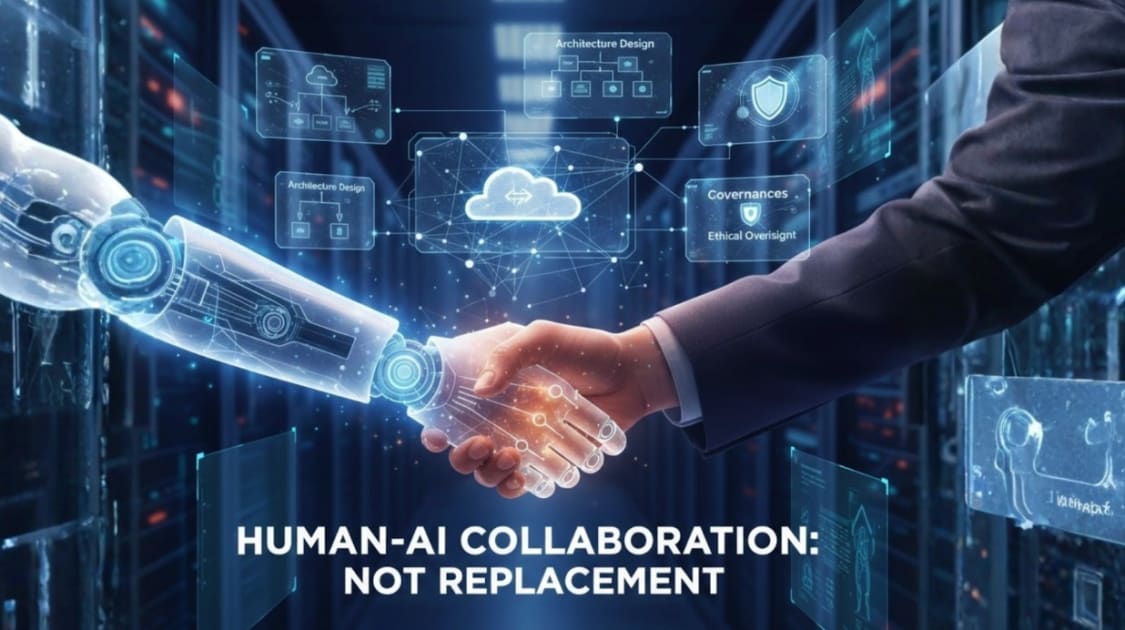
AI and automation do not eliminate the need for IT professionals. Instead, they elevate their role. Engineers move away from repetitive monitoring and manual troubleshooting toward architecture design, governance, and continuous improvement.
This human-AI collaboration model is increasingly central to SNS Square Agentic AI platforms, where intelligent systems augment decision-making while humans provide oversight, strategy, and ethical governance.
The Future of IT Infrastructure Is Agentic
As enterprises continue their digital transformation journeys, IT infrastructure management will increasingly resemble an intelligent ecosystem rather than a collection of tools. AI agents will monitor, decide, and act across environments, coordinating seamlessly with human teams.
Organizations investing early in AI-driven infrastructure, particularly within AI-native Global Capability Centres, will gain long-term advantages in resilience, cost efficiency, and operational excellence.
Closing Perspective
AI and automation are no longer optional enhancements to IT infrastructure management. They are foundational capabilities for enterprises operating at scale in a digital-first world.
By enabling proactive operations, faster resolution, cost optimization, and resilient systems, AI transforms infrastructure from a support function into a strategic enabler. For organizations embracing Agentic AI and modern GCC models, this shift is not just about efficiency, it is about building infrastructure that can think, adapt, and grow with the business.
The future of IT infrastructure is not manual. It is intelligent, autonomous, and collaborative.
Comments0
Please login to join the conversation
Be the first to comment!