
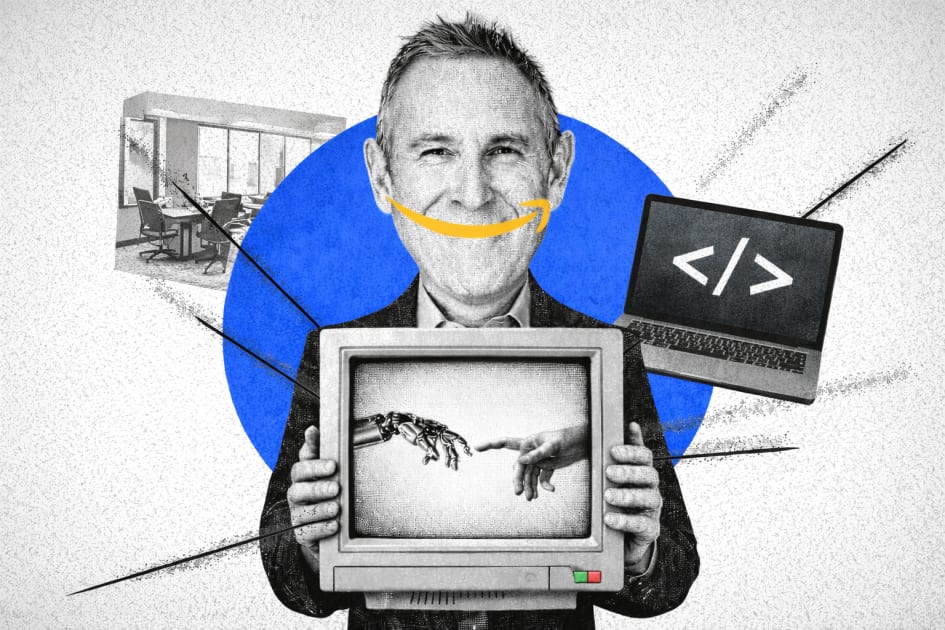
Concerns about artificial intelligence replacing human workers have dominated headlines for years. Yet industry leaders increasingly argue that the real story is not job loss, but job transformation. Recent remarks from Amazon CEO Andy Jassy reinforce a growing consensus across global enterprises: AI will fundamentally reshape how work is done, not whether work exists.
For organizations navigating digital disruption, this distinction is critical. The future of employment will be defined less by disappearance and more by reinvention.
From Labor Replacement to Capability Expansion
Jassy acknowledged that many roles dependent on manual or repetitive human effort may require fewer people as AI systems take over routine tasks. However, he emphasized that this shift mirrors every major technological transition in history. New technologies consistently eliminate certain activities while creating entirely new categories of work.
Rather than removing humans from the equation, AI changes where human value lies.
Tasks that are predictable, rules-based, or data-heavy are increasingly automated. In contrast, roles requiring judgment, creativity, empathy, strategic thinking, and complex problem-solving are becoming more important.
This transition is already visible across sectors adopting enterprise AI and agentic AI capabilities.
The Pattern of Technological Change
Historical precedent strongly supports this outlook. Over the past 150 years, innovations such as electricity, mechanized agriculture, computing, and the internet dramatically transformed industries. Each wave reduced demand for some roles while generating entirely new professions.
Morgan Stanley’s recent analysis echoes this pattern. While automation will alter job structures, most workers are expected to transition into new roles rather than exit the workforce permanently. Many of these future roles do not yet exist, making workforce adaptability the key success factor.
A well-known example is the introduction of spreadsheets in the 1980s. Automated calculations reduced clerical workloads but enabled finance professionals to perform deeper analysis, forecasting, and strategic planning. The result was not job destruction but the expansion of the finance sector into higher-value functions.
AI is poised to produce a similar shift across knowledge work.
The Rise of Human–AI Collaboration
Modern AI systems are not merely tools but collaborators. They analyze large datasets, identify patterns, and generate insights at speeds impossible for humans alone. This allows employees to focus on interpretation, decision-making, and innovation.
In AI-enabled organizations, workers increasingly supervise, guide, and refine machine outputs rather than perform tasks manually. Roles evolve from execution to orchestration.
At SNS Square, this evolution is central to the vision of agentic AI–driven enterprises, where humans and intelligent systems operate as complementary partners.
Examples of emerging roles include:
AI trainers and model supervisors
Data ethics and governance specialists
Human–AI interaction designers
Autonomous systems operators
Decision intelligence analysts
AI-enabled product managers
These roles highlight how AI expands opportunity even as it changes skill requirements.
Skills for the AI Era
The workforce of the future will prioritize adaptability over specialization alone. Technical skills will remain important, but so will capabilities that machines cannot easily replicate.
Key competencies likely to grow in importance include:
Critical thinking and complex problem-solving
Emotional intelligence and communication
Creativity and innovation
Strategic reasoning
Cross-disciplinary collaboration
Digital and AI literacy
Organizations investing in reskilling and upskilling are better positioned to capture AI’s benefits while maintaining workforce stability.
Enterprise Transformation Requires Workforce Transformation
AI adoption is not purely a technology initiative. It is an organizational redesign challenge. Companies must rethink job structures, workflows, and leadership models to fully leverage intelligent systems.
Global Capability Centers (GCCs) are increasingly becoming hubs for this transformation. By combining technical expertise, domain knowledge, and operational scale, GCCs enable enterprises to redesign processes around AI rather than simply layering automation onto existing models.
This shift moves organizations from labor-intensive operations toward intelligence-driven performance.
Economic Impact: Evolution, Not Collapse
Fears of widespread unemployment often stem from short-term disruption rather than long-term outcomes. While certain roles may decline, economic systems historically adjust through new industries, services, and business models.
AI itself is creating entirely new markets, from autonomous systems to personalized digital services and advanced analytics platforms. These sectors will require skilled professionals across technical, operational, and strategic functions.
The net effect is likely to be workforce evolution rather than contraction.
A Human-Centered Future of Work
Ultimately, the most resilient organizations will be those that treat AI as a tool for human amplification, not replacement. Leaders must communicate clearly, invest in talent development, and foster cultures that embrace continuous learning.
The future of work will not be defined by machines taking over, but by humans working differently.
As Andy Jassy’s perspective suggests, history does not support the narrative of technological unemployment. Instead, it reveals a consistent pattern: technology removes constraints, enabling people to focus on more meaningful and higher-impact activities.
For enterprises and employees alike, the question is no longer whether AI will change jobs. It already is.
The real question is how quickly organizations can prepare their workforce to thrive in an AI-powered world.
Comments0
Please login to join the conversation
Be the first to comment!