
Introduction
For years, supply chain control towers have helped enterprises monitor shipments, track inventory, coordinate suppliers, and identify operational disruptions. They have brought information from different parts of the supply chain into centralized dashboards, giving decision-makers a clearer picture of what is happening across their networks.
But visibility alone does not solve a disruption.
When a shipment is delayed, a supplier misses a commitment, or demand suddenly increases, someone still needs to investigate the situation, evaluate alternatives, coordinate stakeholders, and decide what happens next. In complex supply chains, this process can take longer than the disruption itself.
In 2026, the conversation is shifting from connected visibility to intelligent decision-making. AI-powered control towers are evolving beyond monitoring systems into environments that can analyze operational signals, anticipate potential disruptions, evaluate responses, and coordinate approved actions.
The next generation of supply chain control towers will not simply show organizations what is happening. They will help determine what should happen next.
1. Why Traditional Supply Chain Control Towers Are No Longer Enough
Traditional control towers primarily focus on collecting and displaying information from multiple operational systems.
They provide visibility into shipment locations, inventory levels, supplier performance, order status, and logistics activity. This helps supply chain teams identify problems and monitor operational performance.
However, many control towers remain dependent on human intervention to translate alerts into decisions.
Consider a manufacturer whose critical component shipment is delayed. A conventional control tower may identify the delay and notify the procurement team. But resolving the issue requires several additional steps:
Identifying which production schedules are affected.
Checking available inventory and alternative suppliers.
Evaluating the financial and operational impact.
Coordinating with procurement, logistics, and production teams.
Deciding whether to expedite shipping or adjust production plans.
When this information is spread across disconnected applications, even a clearly identified disruption can take hours or days to resolve.
The limitation is not necessarily a lack of visibility. It is the gap between identifying a problem and coordinating an effective response.
2. From Monitoring to Predictive Supply Chain Intelligence
AI introduces the ability to analyze patterns across large volumes of operational data and identify potential disruptions before they become major problems.
Instead of relying exclusively on predefined alerts, AI-powered systems can examine information from supplier updates, inventory records, transportation networks, demand forecasts, and production schedules.
This enables organizations to identify signals such as:
Potential supplier delivery delays.
Unexpected changes in customer demand.
Inventory shortages across critical product categories.
Unusual transportation or logistics patterns.
Production bottlenecks caused by material availability.
Emerging risks across supplier and distribution networks.
For example, an AI system monitoring a manufacturing supply chain could identify that a delayed shipment is likely to affect a production line several days before the available inventory is exhausted.
It could then assess the potential impact on production schedules and highlight alternative sourcing or inventory allocation options.
This changes the role of the control tower from reporting operational conditions to helping organizations anticipate their consequences.
3. Agentic AI: Turning Supply Chain Insights Into Action
The next evolution of supply chain control towers involves Agentic AI.
Traditional analytics systems primarily provide information, predictions, or recommendations. AI agents can extend these capabilities by performing defined tasks, interacting with enterprise applications, and coordinating multi-step workflows within approved boundaries.
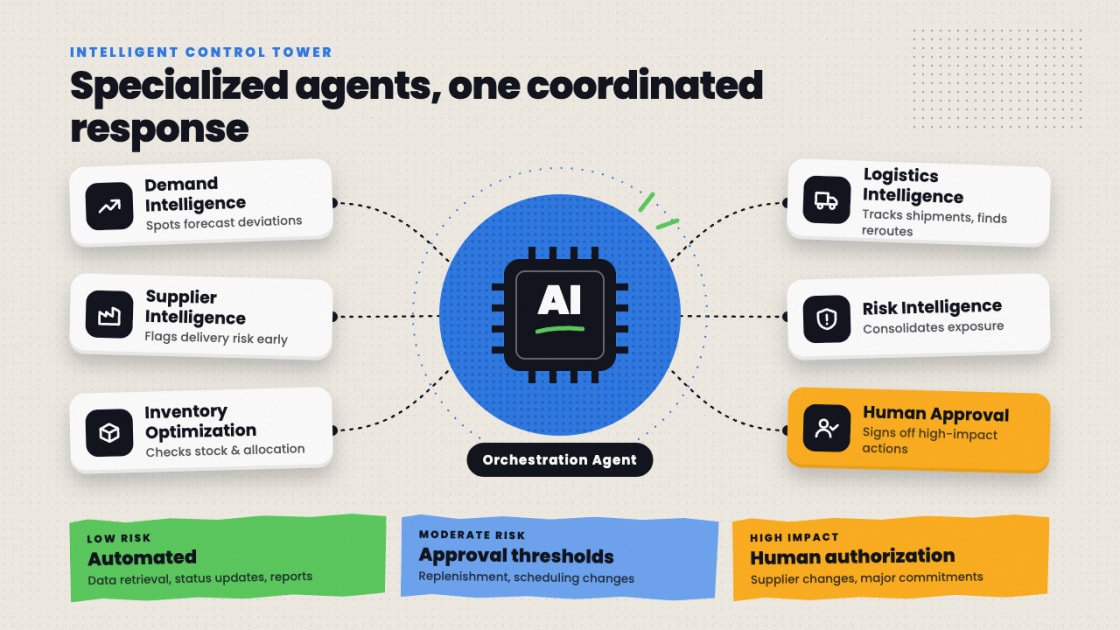
A supply chain control tower powered by multiple specialized agents could include:
Demand Intelligence Agent: Analyzes demand patterns, identifies forecast deviations, and highlights potential changes in customer requirements.
Supplier Intelligence Agent: Monitors supplier performance, evaluates delivery risks, and identifies potential sourcing concerns.
Inventory Optimization Agent: Examines stock availability, replenishment requirements, and inventory allocation opportunities.
Logistics Intelligence Agent: Tracks shipment movements, identifies transportation disruptions, and evaluates alternative routing options.
Risk Intelligence Agent: Consolidates information from different sources to assess potential operational exposure.
Workflow Orchestration Agent: Coordinates activities across specialized agents, prepares recommendations, and routes decisions for approval.
These agents can work together to support a connected supply chain workflow.
For example, when a supplier delay is detected, the supplier intelligence agent can identify the issue, the inventory agent can assess available stock, and the demand agent can determine which customer orders may be affected. The orchestration layer can bring these findings together and prepare possible responses for the responsible team.
The result is a more coordinated approach to disruption management, rather than a collection of disconnected alerts.
4. Scenario Planning: Evaluating Decisions Before Executing Them
One of the most valuable capabilities of an intelligent control tower is its ability to help organizations evaluate alternative responses.
A supply chain disruption rarely has only one possible solution. Expediting a shipment may protect delivery commitments but increase transportation costs. Switching suppliers may reduce immediate risk but introduce quality or qualification concerns. Reallocating inventory may protect one customer while affecting another.
AI-powered scenario analysis can help evaluate these trade-offs.
Consider a sudden increase in demand for a critical product.
An intelligent control tower could examine several possible responses:
Increase production using available capacity.
Reallocate inventory from lower-priority locations.
Expedite incoming materials.
Engage alternative suppliers.
Adjust delivery schedules based on customer priorities.
AI can help compare these scenarios against operational constraints, estimated costs, delivery commitments, and business priorities.
Simulation and predictive analytics can further help organizations understand the potential consequences of different decisions before implementation.
The final decision should remain with authorized supply chain professionals when it involves significant financial commitments, customer obligations, supplier changes, or operational risk.
5. The Technology Foundation Behind an Intelligent Control Tower
An AI-powered control tower cannot operate effectively if enterprise information remains fragmented.
It requires an integrated architecture that connects data, applications, AI agents, and operational workflows.
Four capabilities are particularly important.
Unified Data Foundation: Connects information from ERP systems, warehouse management platforms, transportation systems, procurement applications, supplier portals, and IoT devices.
AI and Agent Layer: Supports demand forecasting, supplier analysis, inventory intelligence, risk identification, and specialized workflow agents.
Orchestration and Integration Layer: Coordinates agent activities and connects recommendations with the enterprise systems responsible for operational execution.
Security and Governance Layer: Establishes access permissions, decision boundaries, audit trails, monitoring, and approval requirements.
Together, these capabilities create a connected environment where operational information can move across departments and AI agents can support decisions using relevant business context.
Data quality is particularly important. Inconsistent inventory records, outdated supplier information, and delayed shipment updates can undermine even sophisticated AI systems.
Organizations must therefore strengthen their data foundations before expanding autonomous capabilities.
6. Why Human Oversight Remains Essential
The evolution towards autonomous supply chains does not mean removing people from critical decisions.
Supply chain operations involve commercial relationships, contractual obligations, customer priorities, regulatory requirements, and unexpected conditions that may not be fully represented in available data.
AI agents can identify risks, evaluate alternatives, and coordinate routine activities. However, decisions involving supplier replacement, major financial commitments, production changes, or customer delivery priorities may require human authorization.
A practical model assigns autonomy according to the risk and impact of each action.
Low-risk activities: Routine data retrieval, status updates, and report preparation can often be automated.
Moderate-risk activities: Replenishment recommendations and scheduling adjustments may require defined approval thresholds.
High-impact activities: Supplier changes, major purchasing commitments, and significant production decisions should retain appropriate human authorization.
This balance allows organizations to benefit from AI-driven speed without compromising accountability.
The objective is not complete automation. It is better coordination between human expertise and machine intelligence.
7. Measuring the Business Value of Intelligent Control Towers
Deploying an AI-powered control tower should produce measurable operational improvements.
Supply chain leaders should evaluate its impact through indicators such as:
Time required to identify and respond to disruptions.
Supplier delivery performance.
Inventory accuracy and availability.
Forecast accuracy.
Order fulfilment and on-time delivery rates.
Logistics and expedited transportation costs.
Production downtime caused by material shortages.
Percentage of routine exceptions resolved through approved automated workflows.
Organizations should establish baseline performance before implementation and evaluate improvements through focused pilots.
The ability to detect a disruption earlier is valuable, but the real business impact comes from resolving it more effectively.
How SNS Square Fits Into Intelligent Supply Chain Transformation
For enterprises modernizing supply chain operations, the challenge is connecting data, AI capabilities, and operational systems into a coordinated decision-making environment.
SNS Square's focus on Data and Agentic AI, intelligent automation, and enterprise integration aligns with the architectural foundations required for intelligent supply chain operations.
Through its Agentic Workbench approach, organizations can explore specialized AI agents and coordinated workflows for supplier intelligence, inventory analysis, logistics monitoring, risk identification, and operational exception management.
By combining orchestration, integration, and governance, the approach supports the development of connected AI capabilities that can operate within enterprise systems while maintaining appropriate human oversight.
The focus is on moving beyond isolated analytics and building intelligent workflows around measurable supply chain challenges.
Conclusion
Supply chain control towers are entering a new phase of evolution.
What began as a way to centralize operational visibility is becoming an opportunity to connect intelligence, evaluate decisions, and coordinate responses across complex enterprise networks.
AI and multi-agent systems can help organizations identify disruptions earlier, understand their operational impact, and coordinate appropriate actions across procurement, logistics, manufacturing, and inventory management.
However, successful implementation depends on more than advanced AI models. It requires connected data, reliable enterprise integration, clear decision boundaries, and governance that keeps people accountable for critical outcomes.
The future of supply chain management will not be defined by how many dashboards organizations operate or how many alerts they generate.
It will be defined by how effectively they turn information into decisions and decisions into coordinated action.
Comments0
Please login to join the conversation
Be the first to comment!