
Introduction
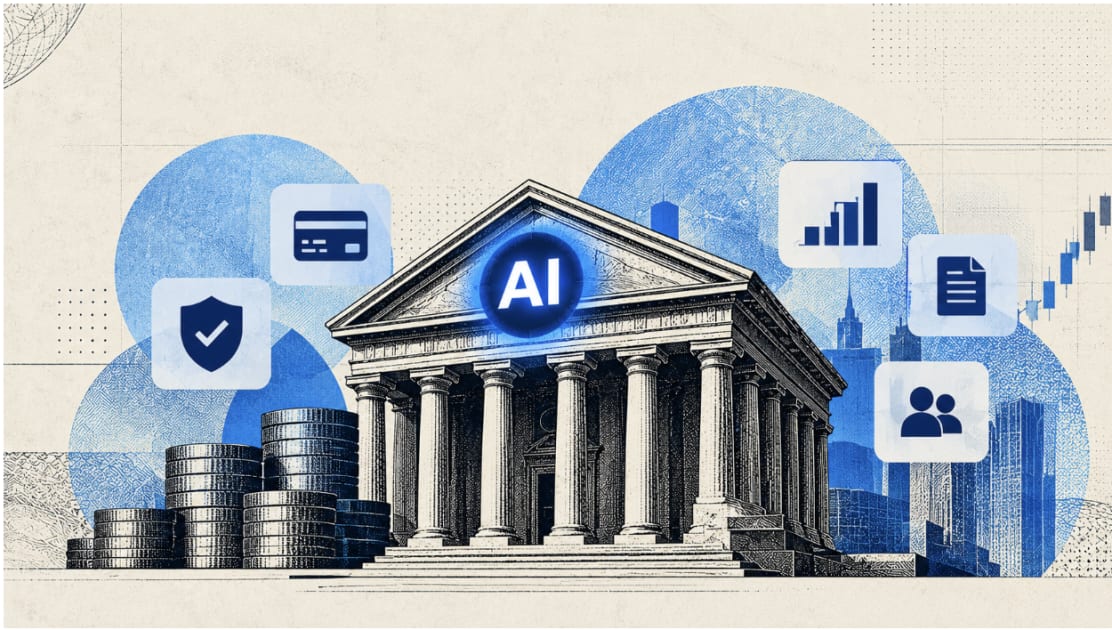
Banking, financial services, and insurance are entering a new phase of artificial intelligence adoption.
Early implementations of AI in BFSI largely focused on customer-facing applications such as chatbots, fraud detection, personalized recommendations, and automated document processing. These applications demonstrated how AI could improve speed, accuracy, and customer experience.
The next phase is broader.
AI is increasingly moving into the operational core of financial institutions, supporting processes across lending, compliance, risk, claims, payments, finance, and customer service.
The evolution is moving from AI that assists people to AI that can coordinate defined workflows and support autonomous financial operations under appropriate governance.
From Customer Assistance to Enterprise Intelligence
Customer service remains one of the most visible applications of AI in BFSI.
AI-powered assistants can respond to routine queries, provide account information, explain products, track applications, and support customers across digital channels.
But customer interactions are only one part of the financial value chain.
Behind every interaction are complex processes involving data verification, risk assessment, documentation, compliance, transaction processing, and operational decision-making.
AI can connect these processes and help financial institutions build a more intelligent operating model.
Intelligent Credit and Lending
Lending involves evaluating large amounts of financial and customer information.
AI can assist with document processing, income verification, credit assessment, risk analysis, and application workflows.
Instead of requiring employees to manually review every piece of information, intelligent systems can extract relevant data, identify inconsistencies, and prioritize cases that require deeper review.
AI agents can further support multi-step lending workflows by coordinating information across approved systems and helping teams move applications through the appropriate stages.
Human oversight remains important for complex or high-impact decisions.
Transforming Fraud and Risk Management
Financial institutions process enormous volumes of transactions every day.
Detecting suspicious activity requires continuous analysis of transaction patterns, customer behavior, account activity, and other relevant signals.
AI can help identify anomalies and prioritize cases for investigation.
An intelligent fraud workflow can continuously evaluate incoming signals and help investigators understand why a transaction or account has been flagged.
This enables risk teams to focus their expertise where it is most needed while AI handles high-volume monitoring and analysis.
AI-Powered Compliance
Compliance remains one of the most resource-intensive areas of financial operations.
KYC, AML, regulatory reporting, document verification, and transaction monitoring involve large amounts of structured and unstructured information.
AI can assist by extracting information from documents, identifying missing data, comparing records, organizing cases, and supporting investigation workflows.
An AI-powered compliance agent could, within defined controls, collect relevant information, identify potential exceptions, prepare a case summary, and route the case to a compliance professional.
This creates a model where AI accelerates the process while human experts retain responsibility for appropriate decisions.
The Rise of AI Agents in Financial Operations
Traditional automation generally performs predefined tasks.
AI agents introduce a more flexible approach.
An AI agent can interpret a goal, gather information, reason across available context, and coordinate multiple steps within defined permissions.
Consider an Accounts Reconciliation Agent.
Instead of simply matching transactions, it could identify discrepancies, retrieve relevant records, categorize exceptions, prepare an explanation, and route unresolved cases to the finance team.
Similarly, a Customer Service Agent could understand a request, retrieve approved customer information, complete eligible actions, and escalate complex cases with the relevant context.
The shift is from task automation to workflow intelligence.
Autonomous Financial Operations
The long-term opportunity is to create financial operations where multiple AI agents work across interconnected processes.
Consider a digital banking environment where:
A customer submits a loan application.
An AI system processes the documentation.
A risk agent evaluates relevant information.
A compliance agent performs required checks.
An operations agent coordinates workflow updates.
A customer service agent communicates status.
Human teams intervene when exceptions require judgment.
Instead of each process operating independently, intelligent systems can coordinate the workflow across the enterprise.
This does not mean removing human oversight.
It means allowing AI to handle more of the operational complexity while people focus on decisions that require expertise, accountability, and context.
Personalization at Scale
AI also enables financial institutions to move toward more personalized customer experiences.
Instead of providing the same information to every customer, AI systems can use approved customer context to provide more relevant interactions.
This can support:
Personalized financial guidance
Product recommendations
Proactive service notifications
Application assistance
Context-aware customer support
Customized digital experiences
The goal is to make financial services more responsive without creating additional manual workload.
Governance Is the Foundation
Greater autonomy brings greater responsibility.
Financial institutions operate in highly regulated environments, making governance essential for any AI deployment.
Organizations need clear controls around data access, privacy, security, model monitoring, auditability, decision authority, and human escalation.
AI agents should operate within defined boundaries, particularly when interacting with financial systems or processes involving significant customer or business impact.
The objective is not unrestricted autonomy.
It is controlled intelligence with measurable accountability.
Building the Intelligent BFSI Enterprise
Successful AI adoption requires more than selecting a model or deploying a chatbot.
Financial institutions need a strong foundation that connects:
Data → AI Models → Enterprise Systems → Agents → Governance → Human Oversight
This architecture allows AI capabilities to scale across multiple use cases while maintaining consistency and control.
Organizations can begin with targeted, high-volume processes and gradually expand toward more complex workflows as capabilities and governance mature.
The SNS Square Perspective
At SNS Square, we view AI transformation in BFSI as a journey from assistance to intelligence and ultimately to governed autonomy.
AI agents can support financial institutions across customer service, lending, risk, compliance, operations, fraud management, and finance.
Through an enterprise-oriented approach to AI, organizations can connect intelligent agents with business systems and workflows while maintaining security, governance, and human oversight.
The focus is on building AI capabilities that address real operational challenges and create measurable business outcomes.
Conclusion
AI in BFSI is moving beyond the chatbot.
The next generation of financial services will combine AI-powered customer experiences with intelligent operational systems capable of analyzing information, coordinating workflows, and supporting decisions at enterprise scale.
The transformation can be viewed as a progression:
Assist → Automate → Predict → Coordinate → Act
The future of financial operations will not be defined by how much AI an institution deploys, but by how intelligently it connects AI with its people, processes, data, and governance.
From helping customers find answers to helping financial institutions execute complex operations, AI is becoming an increasingly important operating layer across BFSI.
Comments0
Please login to join the conversation
Be the first to comment!