

The global banking industry is entering a decisive transition point. Artificial intelligence, once introduced as a productivity enhancer, is now beginning to reshape the very structure of financial institutions. Recent industry estimates suggest that up to 200,000 banking roles in Europe alone could be impacted by AI-driven automation by 2026.
While headlines focus on job losses, the deeper story is not about reduction. It is about reconfiguration. Banking is moving from human-heavy operational models to AI-led, decision-centric operating systems.
At SNS Square Bengaluru, this shift is already visible in how financial enterprises are redesigning their Global Capability Centres, moving from traditional execution hubs to Agentic AI–powered centers that focus on outcomes, intelligence, and resilience.

Why Banking Is at the Epicentre of AI Transformation
Banking has always been data-intensive, rule-driven, and process-heavy. These characteristics make it one of the most natural candidates for AI adoption, particularly in areas such as:
Back-office operations
Risk and compliance monitoring
Transaction processing and reconciliation
Customer query handling
Fraud detection and surveillance
Advances in machine learning, large language models, and autonomous agents now allow these functions to be executed faster, more accurately, and continuously, without human intervention.
This is not incremental automation. It is a structural shift from task execution to decision automation.
From Automation to Agentic AI in Financial Services
What distinguishes the current wave of AI from earlier automation is agency. Modern AI systems do not merely follow predefined rules. They interpret context, plan actions, and adapt to changing conditions.
In banking environments, this means:
AI agents monitoring compliance in real time
Risk systems that adapt dynamically to market signals
Operations platforms that self-correct exceptions
Customer systems that personalise interactions autonomously
This transition aligns closely with the SNS Square Agentic AI Platform philosophy, where enterprises move from fragmented automation to end-to-end agentic workflows that operate with accountability and governance.
Why Europe Is Feeling the Impact First
European banks, in particular, are under intense pressure from:
Tight regulatory frameworks
Rising operational costs
Margin compression
Legacy technology stacks
As a result, many institutions are accelerating AI adoption to remain competitive. Middle- and back-office roles, which rely heavily on repeatable processes, are the first to be transformed.
However, transformation does not imply elimination alone. It implies role evolution.
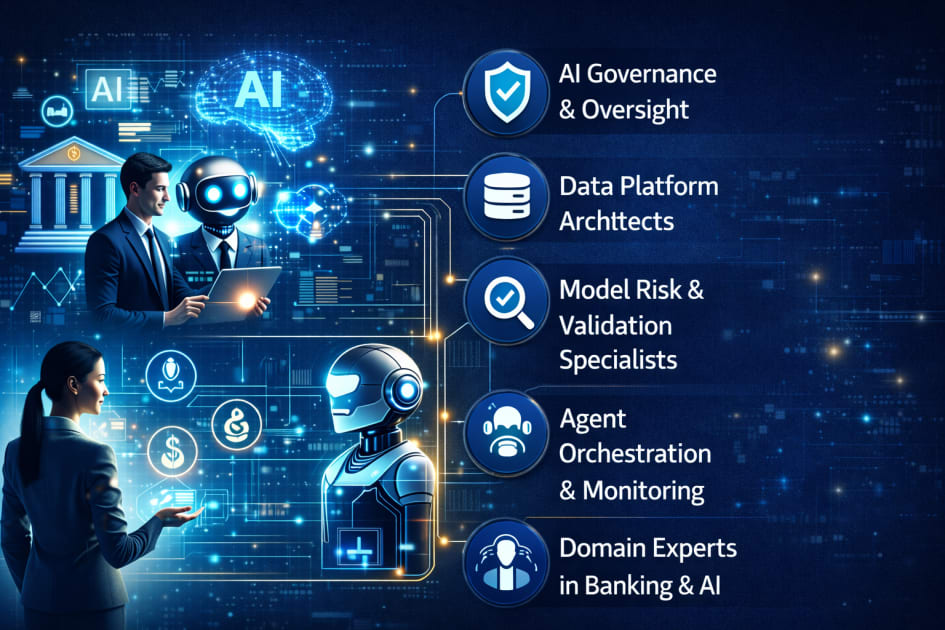
The Real Challenge: Skills, Not Headcount
The most critical risk facing banks is not job loss. It is a skills mismatch.
As AI takes over execution-heavy functions, demand is rising for:
AI governance and oversight roles
Data platform architects
Model risk and validation specialists
Agent orchestration and monitoring experts
Domain leaders who understand both banking and AI
This is where Agentic AI GCC Bengaluru models become essential. Rather than reducing workforce capacity, leading banks are re-skilling and re-architecting talent around AI-native operating models.
At SNS Square Bengaluru GCC, financial institutions are guided through this transition by combining:
Data-to-Agentic AI transformation
Enterprise-grade governance frameworks
Talent upskilling through AI associate models
Reimagining the Role of Global Capability Centres
The traditional Global Capability Centre Bengaluru model focused on scale, cost efficiency, and execution. That model is now insufficient.
The next-generation GCC:
Acts as an AI decision engine
Owns intelligent workflows, not just processes
Operates autonomously with human oversight
Aligns directly with business outcomes
This evolution is already taking shape in environments such as GCC Build Embassy TechVillage, where enterprises are investing in agent-native platforms rather than incremental AI pilots.
What Banking Leaders Should Focus on Now
The banking workforce reset underway in 2026 sends a clear signal to leadership teams:
AI strategy is no longer optional, and it cannot be siloed.
Key priorities must include:
Designing AI-first operating models
Investing in data platforms built for autonomy
Establishing governance for agentic decision-making
Transitioning talent toward AI orchestration roles
Partnering with GCC Build Specialists in Bengaluru who understand enterprise-scale AI
Banks that treat AI purely as a cost-cutting tool risk long-term fragility. Those that treat it as an operational core will emerge stronger, faster, and more resilient.
The SNS Square Perspective
At SNS Square, the focus is not on replacing people with AI. It is on elevating enterprises with AI.
By building Agentic AI Solutions Bengaluru, supported by 150+ Databricks AI Associates and scalable data foundations, organisations are enabled to move from automation to autonomy responsibly.
The 2026 banking workforce shift is not the end of human relevance in finance. It is the beginning of a new operating era where humans design, govern, and guide intelligent systems at scale.
Looking Ahead
The question for banks is no longer whether AI will transform jobs. The real question is how prepared the organisation is to lead that transformation.
Those who act now, redesigning their GCCs, data platforms, and talent strategies, will define the future of intelligent banking.
Those who delay will be forced to react. At SNS Square Bengaluru GCC, the work has already begun.
Comments0
Please login to join the conversation
Be the first to comment!